

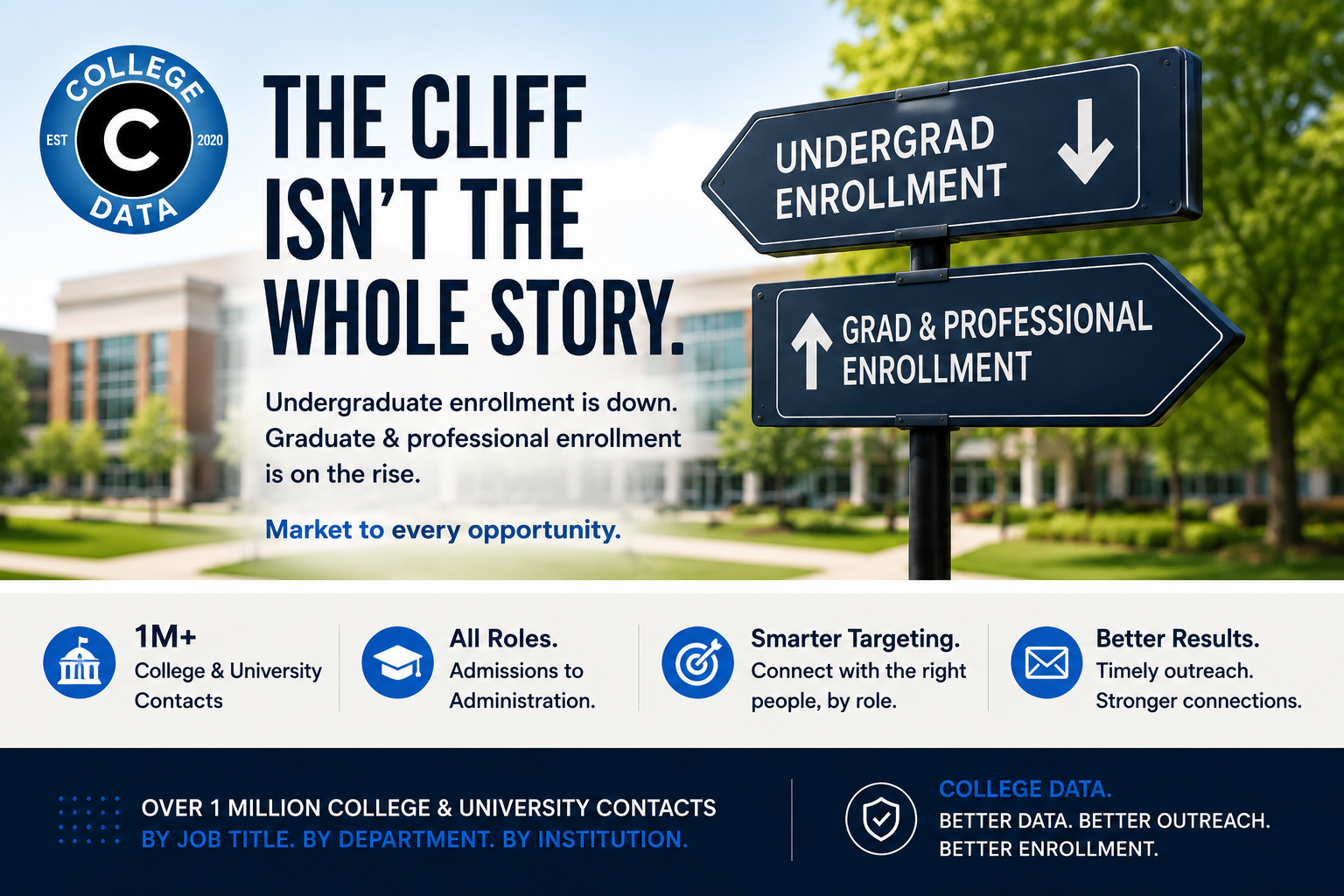
The dominant narrative in higher education coverage for the past several years has been the undergraduate demographic cliff -- the well-documented decline in the number of traditional college-age students available to enroll, and the very real financial pressure this is creating at institutions across the country. That narrative is accurate as far as it goes. It is also incomplete in a way that has caused a meaningful share of vendors to miss a genuine and growing counter-trend.
Graduate, professional, and certificate program enrollment is rising at a significant number of institutions that are simultaneously seeing undergraduate enrollment decline -- and in many cases, the institution's leadership has made a deliberate strategic decision to shift resources toward this side of the house precisely because it represents the institution's clearest path to growth.
Undergraduate enrollment is constrained by a shrinking pool of traditional college-age students -- a demographic fact that no amount of marketing can fully overcome. Graduate, professional, and certificate program enrollment draws from a completely different population: working adults seeking career advancement, professionals pursuing required credentials, and career changers seeking a faster, more targeted credential than a traditional degree.
That population is not shrinking. An institution facing undergraduate headwinds it cannot fully reverse has a genuine strategic incentive to invest aggressively in graduate and professional program growth, because that is where real expansion is actually achievable.
Graduate and professional program administration, at most institutions, runs through an entirely separate organizational structure from undergraduate admissions -- often with its own dean, its own marketing budget, and remarkably little overlap with the undergraduate admissions office that most higher education vendor outreach is built around. A standard university email list built around undergraduate admissions is poorly positioned to reach the graduate school dean or certificate program coordinator who controls this entirely separate and growing budget.
Graduate and professional program leadership is purchasing enrollment marketing and CRM technology specifically configured for the working adult and career-changer audience, which behaves very differently from the traditional 18-year-old undergraduate prospect. Certificate and micro-credential program infrastructure is a particularly active purchasing category as institutions build stackable credential pathways for working adult learners.
This growth is directly connected to the workforce credentialing infrastructure documented in K12 Data's research on grow-your-own teacher certification pipelines, where community colleges and universities building credential pathways are tapping the same population dynamics driving graduate program growth. It also parallels the independent-physician-survival technology stack documented in Physician Data's research on direct primary care and physician group purchasing strategies -- in both healthcare and higher education, the population seeking faster, more targeted credentials or care is growing even as the traditional model is under pressure.
At institutions where graduate enrollment growth has become a genuine strategic priority, the Graduate School Dean or Vice Provost for Graduate Education carries enrollment marketing and technology budget authority that is structurally separate from undergraduate admissions, and that most college administrator email lists have not built out as a distinct, high-priority contact category. This contact frequently reports directly to the Provost or President with explicit growth targets, which means the budget authority attached to the role is meaningfully larger and more directly tied to institutional strategic priorities than the title alone might suggest to a vendor who has not engaged with graduate enrollment leadership before.
Professional programs -- MBA, executive education, professional certificate programs in fields like healthcare administration, education leadership, and public administration -- are frequently run with significant operational and marketing autonomy from the rest of the institution, with program directors who have direct purchasing authority for the enrollment and marketing technology specific to their program's working adult audience. These programs are also frequently evaluated on a revenue and enrollment basis that more closely resembles a business unit than a traditional academic department, which means the program director's incentive to invest in effective enrollment technology is often stronger and more immediate than an undergraduate admissions office operating under a more diffuse institutional mandate.
At many institutions, particularly community colleges and regional comprehensives, continuing education and workforce development leadership is managing the certificate and credential program growth that represents the institution's most active enrollment expansion right now, with budget authority for enrollment technology that standard college mailing lists frequently miscategorize as a subset of general continuing education rather than a primary growth-driving purchasing center. This miscategorization is one of the more correctable errors in higher education contact data, because the role itself is not hard to identify once a vendor knows to look for it specifically rather than assuming it falls under the undergraduate enrollment umbrella.
This is the same growth segment that creates active administrative hiring need on its own distinct timeline, documented in K12 Talent's research on summer administrative hiring across education broadly -- a new certificate program launch frequently requires hiring a program director before the marketing technology purchase even begins. And many of the public institutions building this growth are operating with state appropriation incentives shaped directly by the officials documented in Civic Data's research on state agencies that fund colleges and universities.
• Add Graduate School Dean, Vice Provost for Graduate Education, and Professional Program Director as distinct, high-priority contact categories.
• Segment institutions by graduate and professional program enrollment trend independently from undergraduate enrollment trend.
• Prioritize institutions that have publicly announced new certificate or micro-credential program launches.
• Recognize that the graduate and professional side of an institution frequently has faster, more autonomous decision-making than the undergraduate side.
Graduate and professional program decision-making frequently moves faster than undergraduate admissions technology decisions for the same structural reasons documented across the regional institution research in this content series: fewer stakeholders, a more direct line between the evaluator and the budget authority, and a leadership structure that answers to a specific growth mandate rather than a diffuse set of institutional priorities. A vendor selling into this segment should expect and be prepared for a meaningfully shorter sales cycle than the eighteen-month enterprise evaluation that characterizes a flagship undergraduate admissions technology decision.
The enrollment cliff narrative has correctly identified a real and serious challenge facing undergraduate enrollment at a large share of American higher education institutions. What it has obscured is the genuine growth happening on the graduate, professional, and certificate program side of many of these same institutions -- growth that is run through a separate administrative structure, funded through a separate budget, and almost entirely unreached by the college mailing lists and university email lists most vendors have built around the undergraduate admissions funnel. The vendors who build distinct contact strategies for this growing segment are reaching one of the most active and underexploited purchasing conversations in all of higher education right now, at a moment when undergraduate-focused vendor strategies are running into genuine demographic headwinds that no amount of better marketing can fully overcome.
K12 Data -- Build a List | Pricing | Blog College Data -- Build a List | Pricing | Blog Physician Data -- Build a List | Blog Civic Data -- Build a List | Blog K12 Talent -- Post a Job | Search Jobs | Blog




 0
0
POST A COMMENT