

Higher education vendor marketing teams spend enormous time and energy optimizing their email campaigns. Subject line testing. Send time optimization. Segmentation refinements. Content personalization. A/B testing of calls to action. These are all legitimate marketing disciplines and they produce real improvements in the campaigns that actually reach inboxes.
The problem is that a growing share of higher education vendor email is not reaching inboxes at all. It is being filtered, quarantined, or rejected before a college administrator ever has the chance to see it -- not because the content is bad, not because the subject line triggered a spam filter, but because the sending infrastructure behind the campaign does not meet the authentication and reputation standards that modern university email systems have implemented at an accelerating pace over the past two years.
This is a deliverability problem, not a content problem. And it is more consequential than any subject line optimization because it determines whether all that content work has any chance of mattering in the first place.
The Microsoft 365 and Google Workspace email platforms that now serve the majority of U.S. colleges and universities have dramatically strengthened their inbound filtering capabilities over the past two to three years. The combination of improved machine learning spam classification, stricter DMARC policy enforcement, and sender reputation scoring that these platforms now apply to inbound email has fundamentally changed the inbox placement environment for external senders targeting .edu addresses.
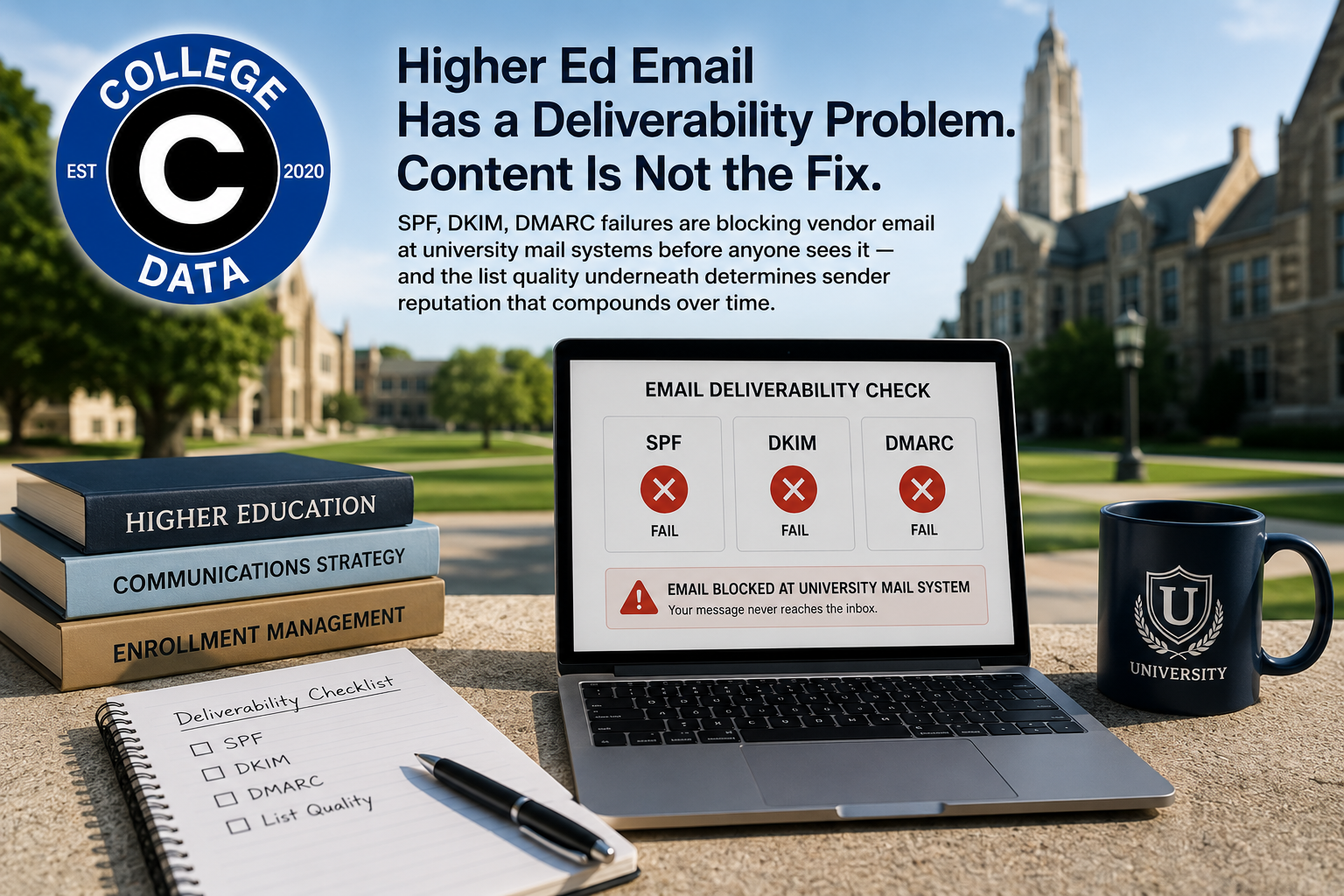
Specifically: universities that have implemented strict DMARC policies -- which instruct receiving mail servers to reject or quarantine email that fails domain authentication checks -- are now blocking a meaningful share of vendor email that was reaching inboxes two years ago. The emails being blocked are not obvious spam. They are legitimate marketing emails from real vendors with real products. They are being blocked because the sender's email infrastructure is missing or misconfiguring SPF records, DKIM signatures, or DMARC alignment -- technical authentication standards that are increasingly non-negotiable for inbox placement at educational institutions.
The vendors experiencing declining open rates in their higher education campaigns are frequently not experiencing declining engagement from recipients who are seeing their emails and choosing not to open them. They are experiencing declining inbox placement -- fewer of their emails are arriving in inboxes at all -- which shows up in the metrics as lower open rates because the denominator of emails that had any chance of being opened is shrinking. Optimizing subject lines to improve open rates on a campaign with a 60 percent inbox placement rate is optimizing the wrong variable.
SPF records tell receiving mail servers which IP addresses are authorized to send email on behalf of a domain. A vendor sending marketing email from an email service provider whose sending infrastructure is not properly listed in the vendor's SPF record will fail SPF authentication at universities with strict DMARC policies -- and that failure will result in the email being rejected or quarantined before delivery. SPF misconfiguration is one of the most common and most fixable deliverability problems in B2B email marketing, and it is disproportionately common among vendors who have changed email service providers or added a second sending platform without updating their DNS records to reflect the change.
DKIM adds a cryptographic signature to outgoing email that allows receiving mail servers to verify that the email was not tampered with in transit and that it genuinely originated from the domain it claims to represent. University email systems that have implemented strict DMARC policies require DKIM alignment -- meaning the DKIM signature must match the sending domain -- for email to pass authentication. Vendors sending through email service providers that use shared DKIM signing rather than per-customer DKIM configuration are frequently failing DKIM alignment in ways that produce deliverability failures at the most sophisticated university email systems.
DMARC is the policy layer that tells receiving mail servers what to do with email that fails SPF or DKIM authentication. Universities that have implemented DMARC policies at p=reject -- the strictest level -- will reject any email that fails both SPF and DKIM authentication. A vendor whose email fails DMARC authentication at a university with a p=reject policy will have zero deliverability at that institution regardless of how relevant their content is or how carefully they have selected their college mailing list contacts.
The deliverability problem in higher education email marketing has a direct parallel in the K-12 email environment documented in K12 Data's research on back-to-school email marketing ROI. School districts are implementing the same Microsoft 365 and Google Workspace configurations at an accelerating rate, which means the authentication standards that are currently most consequential for higher education deliverability are rapidly becoming equally consequential for K-12 vendor email. The vendors fixing their authentication infrastructure for higher education are simultaneously fixing it for K-12 -- and the vendors who have not fixed it yet are accumulating a deliverability deficit that will affect their school district email campaigns as aggressively as their college administrator email campaigns.
Technical authentication is the floor -- the minimum requirement for inbox placement at universities with modern email security configurations. But technical authentication alone does not produce strong deliverability. Sender reputation, which is the second major determinant of inbox placement at university email systems, is built over time through the engagement signals that receiving mail servers observe and communicate back to sending servers.
The most damaging engagement signals for sender reputation are hard bounces -- emails sent to addresses that no longer exist, which generate a permanent delivery failure that damages sender reputation with every sending domain. A college mailing list with significant contact data staleness -- former administrators whose .edu addresses have been deactivated, former deans who have retired and whose email has been removed from university systems -- generates hard bounces at a rate that accumulates sender reputation damage across every campaign sent from the same domain.
A verified, continuously updated college administrator email list is not just a targeting asset. It is a sender reputation asset. Every contact on a verified list that has been recently confirmed as an active, deliverable address is a contact that will not generate a hard bounce -- which means every send from that list is building sender reputation rather than damaging it. The compounding effect of this over months of campaigns is significant: a vendor with a clean, verified list builds a sender reputation that earns better inbox placement over time, while a vendor with a stale list accumulates a reputation deficit that makes inbox placement progressively harder to achieve.
The vendors who have fixed their authentication infrastructure, cleaned their college mailing lists to remove hard bounce sources, and rebuilt their sender reputation with consistent positive engagement signals are reporting a qualitatively different email marketing experience than the vendors still fighting deliverability issues. Open rates are recovering. Response rates are higher. The pipeline contribution from email campaigns is measurable rather than marginal.
The performance benchmarks for well-delivered higher education vendor email are substantially better than the industry averages most vendors compare themselves against -- because those industry averages are contaminated by the deliverability failures of vendors whose technical infrastructure has not kept pace with university email security configurations. A vendor with strong authentication, a clean verified college administrator email list, and a sender reputation built through months of consistent positive engagement signals should be seeing open rates meaningfully above the averages published in most email marketing benchmarks, not below them.
The timing dimension documented in K12 Data's research on back-to-school email marketing conversion windows applies in higher education too. The enrollment planning cycle, FAFSA processing windows, budget authority timing, and the post-summer academic calendar reset all create distinct email engagement peaks that a well-delivered campaign can capture. A vendor with strong deliverability reaching the right contacts at the right moment in the academic planning calendar -- using the graduate program and continuing education administrator contacts documented in earlier College Data research -- is in the most productive position available in higher education email marketing. Build a verified college administrator email list at college-leads.com/build-a-list.
• Audit your SPF, DKIM, and DMARC configuration immediately -- most email service providers provide authentication testing tools, and the results will tell you specifically what is failing and for which receiving domains.
• Run a list hygiene process on your college mailing list before the next major campaign -- remove hard bounce addresses, update contacts at institutions that have migrated email platforms, and flag addresses that have shown no engagement in the past twelve months for a re-engagement sequence before the next full send.
• Set up a seed list of .edu addresses at major university mail systems to monitor inbox placement directly -- if your seed list emails are landing in spam at specific institutions, you have a targeted authentication or reputation problem that can be diagnosed and fixed before a full campaign deployment.
• Check your email service provider's DKIM configuration -- specifically whether they are using per-customer DKIM signing or shared signing infrastructure, because shared DKIM signing is frequently the source of DMARC alignment failures at universities with strict policies.
Higher education email marketing has a deliverability problem that is growing faster than the content optimization conversation is acknowledging. The vendors experiencing declining open rates in their university and college administrator email campaigns are, in a significant share of cases, not experiencing declining engagement -- they are experiencing declining inbox placement driven by authentication failures and sender reputation degradation that no subject line test can fix. The solution is technical and list-quality-driven, not creative. And the vendors who fix it first are building a deliverability advantage that compounds over time, producing campaign performance that their competitors, still optimizing content on top of an authentication infrastructure that is losing the inbox placement battle, cannot replicate.
K12 Data -- Build a List | Pricing | Blog College Data -- Build a List | Pricing | Blog Physician Data -- Build a List | Blog Civic Data -- Build a List | Blog K12 Talent -- Post a Job | Search Jobs | Blog




 0
0
POST A COMMENT