

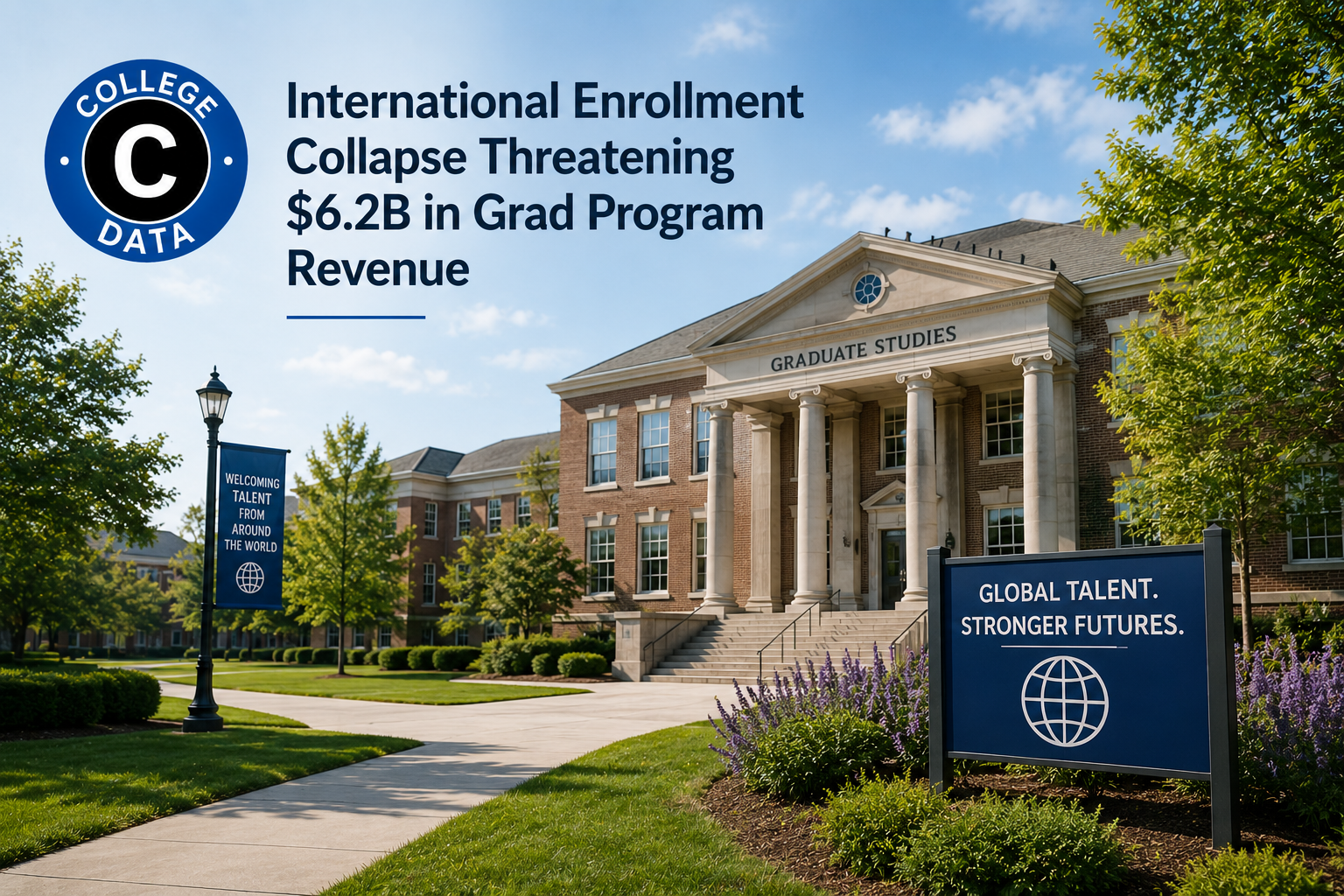
International enrollment has already begun trending sharply downward, and the numbers behind that trend are genuinely alarming for graduate program leadership. A forty-one percent decline in year-over-year webpage visits to Studyportals, a leading international student recruitment platform, suggests a potential six point two billion dollars in lost revenue across all U.S. postgraduate programs by fall 2026, according to Gray DI analysis. This is not a slow, manageable decline institutions can absorb through incremental adjustment. It is a sharp, compressed disruption forcing graduate program leadership into urgent domestic recruitment mode, often for the first time in their careers.
For provosts, graduate deans, and admissions leadership at institutions with substantial international enrollment dependence, this creates a genuine near-term crisis, and it is reshaping who these institutions need to reach and how quickly.
Under current federal policy, international students have faced an expanding vetting process, revoked visas by the thousands, and tightened student visa program requirements generally. This has made the United States a meaningfully less attractive and less predictable destination for prospective international graduate students who have other options, including institutions in other countries actively courting exactly this population as U.S. policy has made American graduate education a riskier bet for international families investing significant resources in an advanced degree.
International students have historically represented a genuine financial lifeline for many graduate programs specifically, since these students frequently pay full tuition without the same institutional aid burden domestic students often require. Losing this population does not just create an enrollment gap. It creates a genuine revenue gap that domestic enrollment alone often cannot fully replace without a real, deliberate strategic response.
International students concentrate disproportionately in graduate and professional programs specifically, particularly in STEM fields where domestic student interest has not kept pace with program capacity built assuming continued international enrollment. A graduate engineering or computer science program that built its enrollment model around a substantial international cohort now faces a genuine structural problem: the domestic applicant pool for these same programs was never sized to fill the gap this decline is creating, since program capacity planning assumed international students would continue filling a meaningful share of available seats.
"There's no obvious way to refill these programs with domestic students. We're going to get hit twice: once in higher ed, and then in our ability to fulfill roles in the workforce."
This double impact, immediate revenue loss and longer-term workforce pipeline disruption in fields the domestic economy genuinely depends on, makes this decline a more consequential story than a typical enrollment fluctuation, extending well beyond individual institutions' balance sheets into broader questions about the country's capacity to fill specialized technical roles going forward.
Graduate program leadership at institutions with significant international enrollment dependence are facing genuine, immediate pressure to build domestic recruitment capability many have simply never needed to develop with real sophistication, since international recruitment has historically operated through a largely separate set of channels, agents, and strategies than domestic graduate recruitment has traditionally relied on. This is not a gradual capability-building exercise institutions can approach at a leisurely pace. Programs facing genuine enrollment shortfalls for the upcoming cycle need functional domestic recruitment infrastructure now, not in two or three years once a more considered strategy has been fully developed.
This urgency is creating real, immediate demand for domestic graduate recruitment marketing, expanded outreach to master's and doctoral-track undergraduate populations who may not have previously considered graduate study at this specific institution, and genuine reconsideration of program positioning and messaging that has, in many cases, never needed to speak directly to a domestic audience with real persuasive intent.
STEM graduate programs, and programs at institutions that have historically marketed heavily toward specific international markets, face the most acute version of this disruption, since their existing recruitment infrastructure and institutional relationships are least transferable to a genuine domestic recruitment strategy. Research-intensive institutions relying on international graduate students to staff laboratory and research assistant positions face a related, compounding pressure, since domestic graduate students have not historically filled these specific roles at comparable volume, creating operational strain beyond pure enrollment numbers alone.
Regional and less internationally recognized institutions, which have historically depended more heavily on aggressive international recruitment specifically because domestic name recognition was more limited, may actually face a somewhat different calculus, since building genuine domestic recruitment capability could represent a durable, long-term institutional investment rather than simply a temporary bridge until international enrollment eventually recovers, if it recovers at all under current policy conditions.
Institutions building genuine domestic graduate recruitment capability for the first time need considerably more than simply redirecting international recruitment budget toward domestic channels. Domestic prospective graduate students research programs differently, respond to different messaging, and make decisions on a different timeline than international applicants typically have, often requiring more direct, personalized outreach earlier in their undergraduate careers rather than the more centralized, agent-driven recruitment model international enrollment has often relied on.
This means institutions need genuinely current, well-segmented contact data reaching undergraduate populations at feeder institutions, working professionals considering a return to graduate study, and other domestic populations most graduate programs have not needed to reach with real precision and urgency before this specific disruption made it a genuine strategic necessity rather than a supplementary recruitment channel.
Consider a mid-size research university's mechanical engineering graduate program, which has historically enrolled roughly sixty percent international students, drawing heavily from specific countries through established agent relationships and university partnerships built over more than a decade. As those international applications decline sharply this cycle, the program faces a genuine structural problem: domestic applications to this same program have historically run at a fraction of what would be needed to fill the resulting gap, since the program's marketing, positioning, and even physical recruitment presence at domestic undergraduate fairs has never been built with real urgency, given how reliably international enrollment filled available seats in prior years.
The program's response, quickly building domestic outreach to nearby undergraduate engineering programs and considerably expanding its presence at domestic graduate fairs, represents exactly the kind of scramble playing out at research-intensive institutions nationwide right now. This is not a hypothetical exercise. Graduate program directors across the country are having genuinely urgent conversations with admissions leadership this cycle about how to close gaps that international enrollment reliably filled for years without requiring this level of strategic attention.
Institutions tempted to redirect their existing international recruitment infrastructure toward domestic prospects directly are often discovering the two audiences require genuinely different approaches. International students frequently apply through agents and respond to institutional reputation and ranking signals prominently featured in international recruitment materials. Domestic students, by contrast, often respond more strongly to direct outreach from current faculty and students, genuine career outcome data specific to the program, and messaging that speaks directly to their own undergraduate experience and career trajectory rather than broad institutional prestige signals alone.
This means institutions building genuine domestic recruitment capability need to invest in fundamentally different messaging and outreach channels, not simply redirect existing international recruitment budget and materials toward a domestic audience that responds to different signals entirely. Programs that make this mistake, treating domestic recruitment as a simple channel substitution rather than a genuinely different strategic approach, are likely to see considerably weaker results than programs building authentic domestic-specific recruitment strategy from the ground up.
Effective domestic graduate recruitment increasingly depends on genuine, sustained relationships with specific undergraduate feeder institutions, the colleges and universities whose graduates represent a program's most likely domestic applicant pool given academic preparation and geographic or institutional affinity. Programs that have relied primarily on international recruitment have often never built these feeder relationships with any real depth, since international enrollment did not require this specific kind of domestic institutional relationship-building.
Building genuine feeder institution relationships takes real time, typically requiring faculty visits, guest lectures, and sustained presence at specific undergraduate institutions over multiple recruitment cycles before yielding a reliable, ongoing applicant pipeline. Programs starting this work now, in direct response to the current international enrollment crisis, are making a multi-year investment that will not fully offset this year's immediate shortfall but that represents genuinely durable infrastructure for future recruitment cycles regardless of how international enrollment ultimately evolves.
Beyond recruitment strategy itself, institutions with significant international enrollment exposure need honest, near-term financial planning that accounts for this revenue gap directly rather than assuming it will resolve through recruitment effort alone within a single cycle. A graduate program that has relied on international tuition revenue for a meaningful share of its operating budget cannot simply market its way to an immediate, full replacement of that revenue, since building genuine domestic recruitment capability takes real time to reach full effectiveness, typically longer than a single admissions cycle allows.
This means institutional financial planning should treat this disruption as a multi-year transition requiring genuine budget flexibility, not a single-cycle problem solvable through one aggressive marketing push. Programs that plan for immediate full recovery risk genuine financial strain if domestic recruitment, however well-executed, does not fully close the gap within the first year, a realistic outcome given how long genuine feeder institution relationships and domestic recruitment infrastructure actually take to mature into reliable enrollment yield.
This is not the only sector where a previously stable enrollment or workforce pipeline is facing sudden, genuine disruption this year. K-12 districts are navigating a comparable shift, since declining enrollment is forcing districts to build genuine marketing capability many have never needed before. Healthcare is facing a related retention challenge requiring urgent new strategic attention too, since women physicians leaving clinical practice fifteen years earlier than men is forcing practice leaders to rethink retention strategy entirely.
Government agencies are managing a related organizational disruption too, since state legislatures passing thousands of new technology bills this year have created a compliance patchwork most local governments were not staffed to handle, and K-12 hiring reflects a related tension too, since states racing to raise starting teacher pay are inadvertently creating a veteran teacher retention crisis that has received far less attention than the recruitment side of the story.
International graduate enrollment is not simply softening. It is collapsing at a pace that leaves most institutions with genuinely little runway to build an adequate response through incremental adjustment alone. Institutions moving quickly to build genuine, well-targeted domestic recruitment capability, rather than treating this as a temporary disruption to wait out, are positioned to protect graduate program viability in a way institutions still hoping international enrollment simply recovers on its own previous timeline are not. Given how uncertain that recovery timeline genuinely is under current federal policy conditions, waiting is itself a real strategic risk, not a neutral, cost-free choice institutions can make without consequence.
Ready to reach the domestic graduate prospects your programs need right now? Build a higher education marketing database, or buy a college email list, with College Data today.




 0
0
POST A COMMENT