

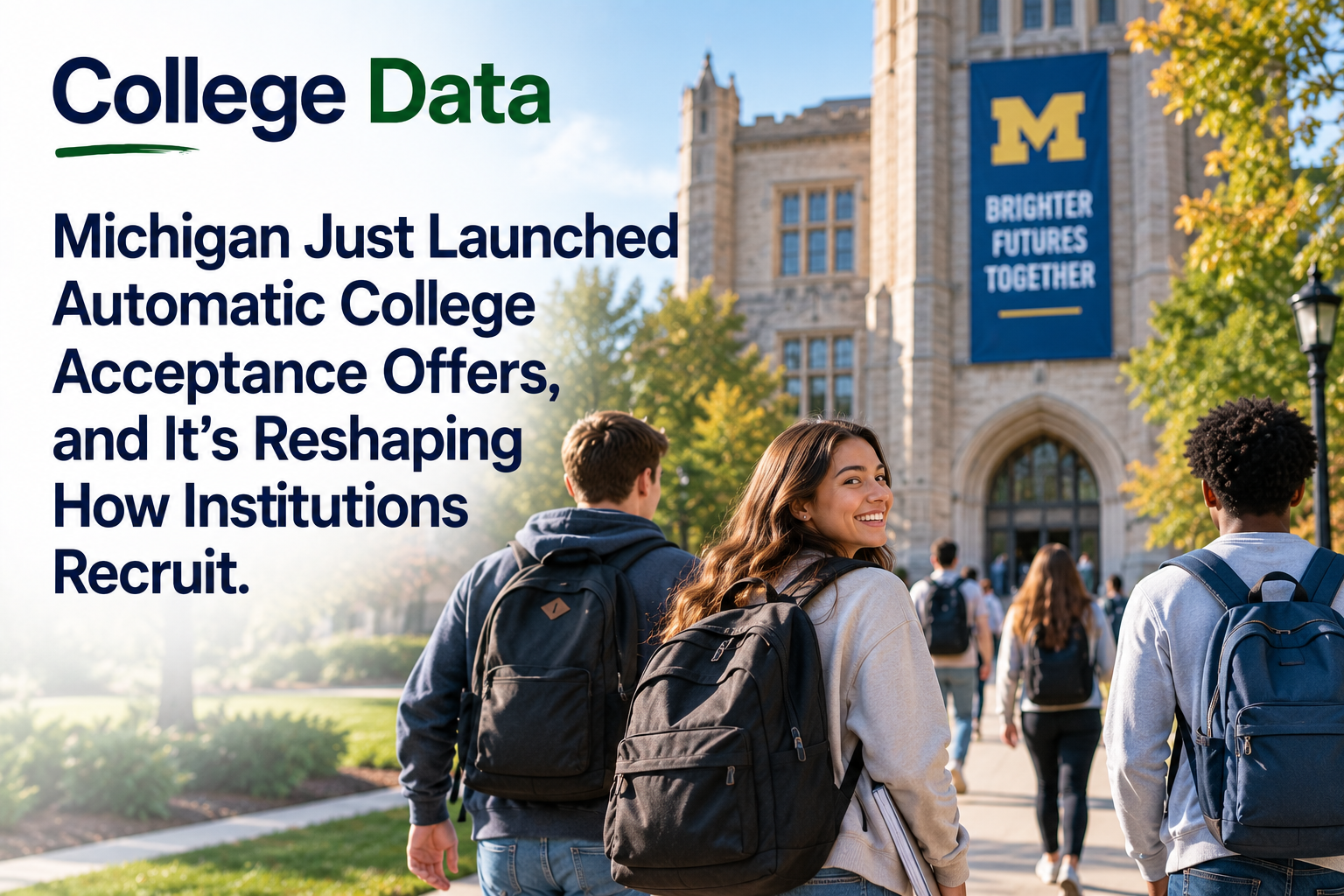
A genuinely significant shift in college recruitment infrastructure deserves direct attention from admissions leadership nationally. Through MI College Match, Michigan students will be able to get automatic acceptance offers by uploading their transcripts to a free online portal, a direct admissions model operating at genuine statewide scale rather than the more limited, institution-specific direct admissions programs that have characterized this approach until now. This represents a meaningfully different recruitment infrastructure model, one removing genuine application friction at a scale most institutions could not achieve independently.
For admissions and enrollment management leadership, particularly at institutions operating within or considering partnership with states building comparable infrastructure, this program offers genuine, concrete insight into where direct admissions technology is actually heading, worth understanding directly both for its immediate implications and for what it suggests about future recruitment infrastructure more broadly.
Direct admissions programs, offering acceptance based on existing academic records without requiring a traditional application, have existed at individual institutions for several years, but implementing this approach at genuine statewide scale, coordinating across multiple participating institutions through a single, unified portal, represents considerably more significant recruitment infrastructure than any single institution's independent direct admissions effort could achieve. This kind of coordinated, statewide approach removes genuine application friction for students who might not have otherwise applied to a full range of institutions actually within their reach academically.
This matters particularly for students who may not have considered a four-year institution a realistic option, either due to genuine uncertainty about their own qualification or the practical burden traditional application processes represent, since automatic acceptance offers based on already-available transcript data removes exactly the kind of application friction that has historically discouraged some qualified students from applying to institutions they might genuinely thrive within.
"Through MI College Match, students will be able to get automatic acceptance offers by uploading their transcripts to a free online portal."
Institutions participating in this kind of statewide direct admissions infrastructure need to reconsider their own recruitment marketing strategy directly, since a student receiving an automatic acceptance offer faces a genuinely different decision-making process than a student who has invested meaningful time and effort into a traditional application specifically to that institution. Institutions should recognize that converting an automatic acceptance offer into genuine enrollment requires different, often more intensive follow-up engagement than converting a traditional applicant who has already demonstrated meaningful interest through the application process itself.
This creates genuine need for institutions to build recruitment communication specifically designed for this direct-admission population, helping students who received an offer with comparatively less upfront institutional research understand why a specific institution genuinely represents a strong fit for their particular academic and career goals, rather than assuming an automatic acceptance offer alone adequately conveys this institutional value proposition.
This kind of program has genuine potential to expand the overall pool of students actually applying to and enrolling in four-year institutions, specifically among students who might not have previously considered themselves strong candidates or who found traditional application processes genuinely burdensome relative to their other post-secondary options. States and institutions should track enrollment outcomes from this program closely, since genuine success at meaningfully expanding college-going rates among previously underserved student populations would represent considerably significant. validation for this kind of coordinated, statewide direct admissions infrastructure investment.
Institutions in other states should watch Michigan's specific implementation and outcomes closely, since a state of Michigan's scale successfully implementing this kind of coordinated direct admissions infrastructure offers considerably more directly relevant insight for other states considering comparable programs than smaller-scale, single-institution direct admissions efforts have historically provided.
Automatic acceptance alone does not guarantee enrollment, and institutions should recognize that genuine follow-through requires pairing this streamlined admissions process with equally clear, accessible financial aid information, since students receiving an automatic acceptance offer still need genuine clarity about actual cost and available aid before enrollment becomes a realistic decision. Institutions participating in this kind of program should evaluate whether their financial aid communication is genuinely calibrated to reach this specific population effectively, rather than assuming existing financial aid marketing built around traditional applicants translates seamlessly to students engaging with the institution through this considerably different admissions pathway.
Consider a high school senior with genuinely strong academic performance who had not planned to apply to any four-year institution, assuming the application process itself represented more effort and uncertainty than pursuing a more immediately accessible post-secondary path. This same student receiving an automatic acceptance offer through MI College Match, based on transcript data the state already possessed, encounters a genuinely different decision point than the one they had originally anticipated, now needing to evaluate a real, concrete offer rather than deciding whether to invest effort in an uncertain application process they might not have pursued at all absent this program's existence.
This scenario illustrates precisely why this kind of program has genuine potential to reach students traditional recruitment marketing and application processes may not have reached effectively, and why institutions receiving these automatically-generated applicants need genuinely thoughtful follow-up engagement treating this population as distinct from traditional applicants who arrived at the institution through a fundamentally different decision-making process already involving meaningful institutional research and interest.
This dynamic, institutions building genuine new infrastructure in direct response to demonstrated need, is showing up across sectors this year. K-12 districts are seeing a related bipartisan finding too, since a majority of Americans across the political spectrum want clear classroom technology guardrails, a new survey finds. Healthcare organizations can find useful terminology grounding directly too, and Physician Data's glossary offers context for exactly this kind of positive trend.
Government agencies are managing a related coordination challenge too, since new AI-specific procurement requirements are pulling a much wider group of stakeholders into technology purchasing decisions that used to sit with a smaller team. And K-12 hiring reflects a related structural pressure too, since new federal loan changes are deepening the teacher shortage right when districts need more candidates, not fewer.
Michigan's statewide automatic acceptance program represents a genuinely significant evolution in direct admissions infrastructure, moving this approach from individual institutional initiatives toward coordinated, state-scale implementation. Institutions participating in or watching this kind of program closely, and building recruitment and financial aid communication specifically calibrated to this considerably different admissions pathway, are positioned to capture real enrollment value from this infrastructure shift more effectively than institutions treating automatic acceptance as requiring no meaningful change to existing recruitment strategy.
Ready to reach the admissions leaders navigating this recruitment infrastructure shift? Build a higher education marketing database, or buy a college email list, with College Data today.




 0
0
POST A COMMENT