

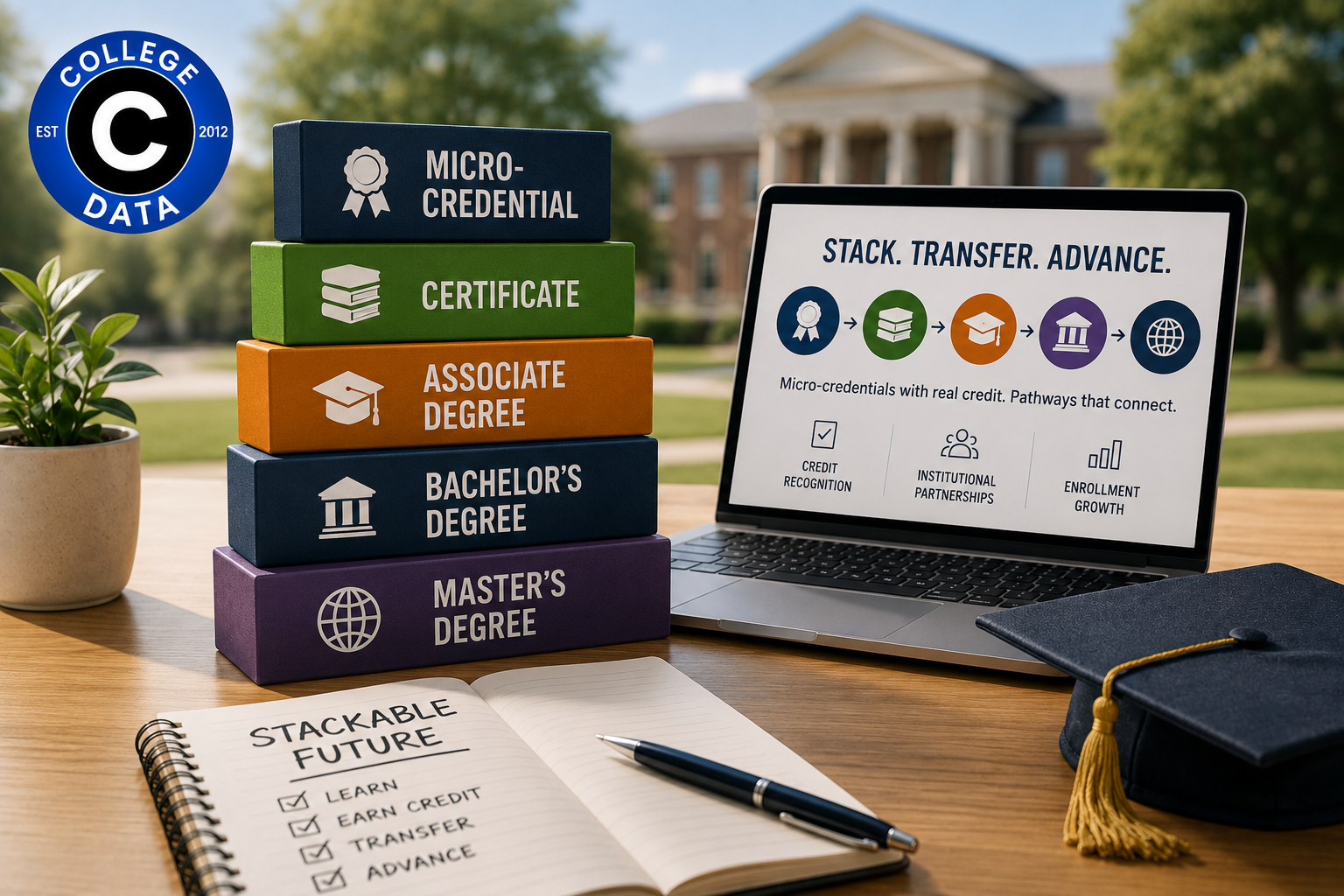
Stackable credentials -- short certificates that earn credit toward a longer credential, which in turn earns credit toward a degree, which in turn earns credit toward an advanced degree -- have been discussed in higher education policy circles for more than a decade as a promising but mostly theoretical approach to making postsecondary education more flexible and accessible for working adults. The theory was always sound. The execution has historically been too complicated, too administratively burdensome, and too poorly supported by existing technology infrastructure to achieve significant scale.
That is changing faster than most higher education vendors have recognized. Stackable credential programs have moved from a policy aspiration to an active enrollment strategy at hundreds of institutions over the past three years, driven by a combination of employer demand for specific, verifiable competencies, adult learner preference for faster and more targeted educational investments, and the financial pressure facing institutions whose undergraduate enrollment is declining while the working adult credential market is growing. The institutions winning this market are competing on the quality and portability of their credential infrastructure, and the technology building that infrastructure is in active purchasing at an accelerating rate.
The historical barriers to stackable credential programs have been administrative and technological rather than conceptual. The administrative challenge: credits need to genuinely stack -- meaning a student who completes a certificate needs to be able to have that certificate's coursework formally credited toward a subsequent degree program, at the same institution or at a partner institution, without having to repeat coursework or navigate a bureaucratic exception process every time. At most institutions, this has historically required either an elaborate series of articulation agreements that are difficult to maintain and often poorly communicated, or a willingness to accept prior learning on a case-by-case basis that creates administrative overhead and unpredictability for students.
The technological challenge: institutions need systems that can track a student's credential accumulation across multiple program enrollments, communicate that accumulation to employers in a verifiable format, and integrate with the student information systems, degree audit tools, and financial aid platforms that govern the rest of the student's academic record. Most existing student information systems were not built to handle a student who is simultaneously an alumnus of a certificate program and a current student in a degree program and a prospective student in an advanced credential program, with credits flowing across all three statuses.
Both of these barriers have begun to fall in the past two to three years. Prior learning assessment platforms have matured to the point where institutions can evaluate and credit prior learning -- including credentials earned at other institutions or through employer training programs -- at a scale and speed that was not operationally possible five years ago. Digital credentialing and badging infrastructure has developed enough that credentials issued by one institution can be verified by employers and recognized by partner institutions without a manual process. And a small but growing number of institutions have invested in the articulation agreement management technology needed to make their stackable pathways actually function as advertised rather than as aspirational policy documents.
The institutions winning the micro-credential stacking market in 2026 are disproportionately regional comprehensive universities and community colleges -- not the brand-name flagship institutions that dominate most vendor target account lists. This is consistent with the pattern documented in earlier research in this series: regional and community college institutions move faster, face more acute financial pressure to develop new enrollment revenue streams, and have less institutional inertia against adopting new program models than their more established peers.
The institutions that have built genuine stackable credential infrastructure have typically made several discrete technology investments that most of their competitors have not: a prior learning assessment platform that can evaluate and credit prior credentials from employers, other institutions, and industry training programs at scale. A digital credentialing system that issues verifiable credentials in a format employers can check and partner institutions can recognize. Articulation agreement management software that maintains live, accurate records of which credentials transfer to which programs at which partner institutions, communicated in real time to students and counselors rather than locked in a PDF document nobody reads.
This technology investment pattern connects directly to the dual enrollment and community college connection documented in K12 Data's research on districts and their community college partners as co-buyers. The stackable credential pathways that are growing fastest are frequently built around the same community college-to-four-year-institution partnerships that drive dual enrollment -- a student who earns a short-term credential at a community college, transfers credit to a four-year institution, and continues stacking toward an advanced degree is navigating multiple institutional relationships simultaneously. The vendors serving this market need contact coverage that spans both community college continuing education leadership and four-year institution transfer and credential program administration.
Prior learning assessment -- the process of evaluating and crediting learning that happened outside a traditional academic program, including employer training, military service, industry certifications, and credentials earned at other institutions -- is the foundational technology requirement for genuine credential stacking. Without a scalable, consistent process for evaluating prior learning, every stacking decision is a one-off exception that creates administrative burden and student uncertainty. Prior learning assessment platforms that integrate with student information systems, apply consistent evaluation frameworks, and generate academic credit recommendations that faculty can review and approve are in active purchasing at institutions that have committed to stackable credential programs as a strategic priority.
The employer verification use case for digital credentials is what has turned stackable credentials from an internal institutional policy into a market differentiator. An employer who can verify a job candidate's credentials in real time, from any issuing institution in a credential network, is an employer who can make faster and more confident hiring decisions based on specific, verifiable competencies rather than generic degree attainment. The institutions issuing verifiable digital credentials are building a network effect -- the more employers who use and trust the credential verification system, the more value the credential has for students, which drives enrollment. Vendors building this network infrastructure are in a genuinely important and currently underserved market.
Articulation agreements govern which credits transfer and how across institutional partnerships. Most institutions manage these agreements through manual processes that produce documents that are rarely current, inconsistently applied, and poorly communicated to the students and counselors who most need to use them. Articulation agreement management platforms that maintain live, searchable, and automatically updated credit equivalency databases are a purchasing priority at institutions building stackable credential pathways because functional articulation infrastructure is what separates a credential stack that actually works for students from one that exists on paper and frustrates everyone who tries to use it.
The employer partnership dimension of this market creates a cross-sector connection worth noting for vendors. Healthcare institutions, school districts, and government agencies that have formal employer training programs are increasingly exploring whether those programs can be formally recognized and credited by partner colleges -- which means Physician Data's research on healthcare workforce education and Civic Data's research on government workforce development programs both touch the same credential recognition infrastructure that college mailing list contacts are purchasing from the institutional side.
This is the most frequently active purchasing contact for stackable credential infrastructure, because continuing education and workforce development divisions are typically the organizational home for short-term and stackable credential programs at most institutions. These deans have direct purchasing authority for the platforms supporting their programs and are operating with a growth mandate that makes technology investment decisions faster and more autonomous than comparable decisions in traditional academic departments.
At institutions that have invested seriously in prior learning assessment, a dedicated Director of Prior Learning Assessment or similar role exists to manage the evaluation process, faculty review workflows, and the technology supporting both. This contact is the primary evaluator for prior learning assessment platforms and is significantly more specialized and harder to identify than a general continuing education or admissions contact.
The administrator responsible for maintaining and managing articulation agreements -- which credits from which institutions transfer to which programs -- is the primary evaluator for articulation agreement management technology. At most institutions this role has never been resourced adequately relative to the volume of articulation agreements it manages, which is precisely why the technology market for this function is growing.
Micro-credential stacking is not a future trend in higher education. It is a present enrollment strategy at hundreds of institutions, built around technology that is in active purchasing now, driven by contacts who are almost entirely absent from the college mailing lists and university email databases most vendors have built around traditional degree program enrollment management. The vendors who have identified and reached the Deans of Continuing Education, Directors of Prior Learning Assessment, and Articulation Agreement Coordinators who are building this infrastructure are competing in a market their competitors have not found. The vendors still routing higher education outreach exclusively through undergraduate admissions and enrollment management contacts are missing one of the most active and fastest-growing purchasing conversations in all of higher education.
K12 Data -- Build a List | Pricing | Blog College Data -- Build a List | Pricing | Blog Physician Data -- Build a List | Blog Civic Data -- Build a List | Blog K12 Talent -- Post a Job | Search Jobs | Blog




 0
0
POST A COMMENT