

Most higher education list vendors sell exactly one thing: a college and university contact database, built once, sold repeatedly, and disconnected from anything happening in K-12 or education employment. That is a reasonable business model, but it has a structural limitation buyers rarely think about until it costs them: a single-purpose database only gets verified and refreshed through its own narrow use case. A college email list that is only ever used for college-focused campaigns only gets error-checked by college-focused customers, which is a much smaller, slower feedback loop than it sounds, and the gap between that loop and a broader one compounds every single month it goes unaddressed.
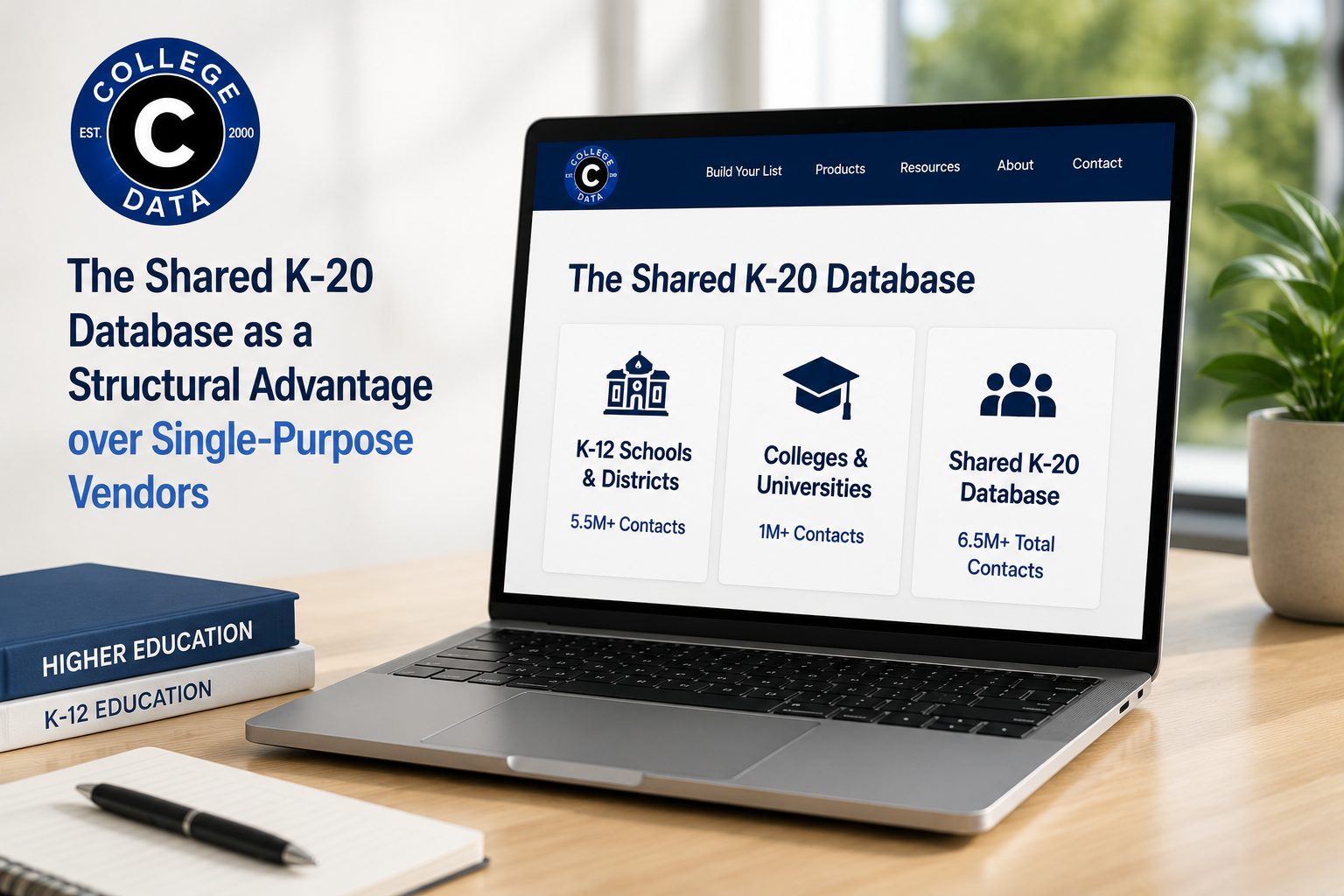
College Data, K12 Data, and K12 Talent draw from one continuously maintained K-20 database, not three separate lists stitched together after the fact. That shared structure is not a marketing detail. It is a genuine data quality advantage that a single-purpose vendor cannot replicate no matter how much they invest in their one product, because the advantage comes from breadth of use, not just depth of research.
Contact data decays constantly. People change roles, change institutions, leave the workforce, or move between sectors entirely, and no research team, however diligent, can catch every one of those changes through a single narrow use case alone. A shared K-20 database gets touched by three genuinely different products serving three genuinely different customer bases, which means errors and changes get surfaced from more directions than a single-purpose list would ever encounter.
A K12 Talent customer posting a job and getting a bounce or an out-of-date response surfaces a data issue that immediately benefits College Data and K12 Data too, since the underlying record lives in the same database. A College Data customer building an admissions director list who flags an incorrect title benefits K12 Talent's next teacher outreach campaign the same way. This cross-pollination effect is structurally impossible for a vendor that only sells one product, because they only ever get one type of feedback loop touching their data.
Education genuinely operates as a connected continuum, not three walled-off sectors, and a shared database reflects that reality in ways a single-purpose vendor's data structure cannot. A district administrator overseeing curriculum decisions today may move into a higher education role tomorrow. A college's education department trains the exact teachers K12 Talent helps districts hire. A superintendent's staffing decisions and a university's teacher preparation program enrollment are directly connected, even though most contact data vendors treat them as completely separate markets with no relationship to each other at all.
A database built and maintained across this full continuum captures relationships and context that a narrower, single-purpose database structurally cannot, because the narrower database was never designed to see the connections in the first place. This matters practically for buyers who work across K-12 and higher education simultaneously, which describes a meaningfully large share of the vendor base selling into education generally, from curriculum publishers to assessment companies to professional development providers.
A vendor that has only ever built a college and university database, with no connection to K-12 or education employment data, is not simply offering a narrower product. They are working with a fundamentally different verification model, one that depends entirely on their own customer base's feedback and their own research team's periodic outreach, without the benefit of a second or third product surfacing changes from an entirely different angle.
This is not a knock on single-purpose vendors' effort or diligence. It is a structural limitation of the business model itself. No amount of additional research staff fully substitutes for the natural, continuous verification that comes from a database being actively used, queried, and stress-tested across three genuinely different products and customer bases simultaneously, each catching different kinds of errors and changes the others might miss entirely.
Beyond verification, coverage itself compounds across a shared database in a way it cannot for a single-purpose vendor. Research conducted to support a K12 Data customer's district administrator list can surface a related higher education contact, such as a district's partnership office working with a local university's teacher preparation program, that would never have been captured by a research process built exclusively around one narrow product. The reverse is equally true, where higher education research surfaces K-12 relationships that strengthen K12 Data's own coverage.
This compounding effect means the shared K-20 database's coverage grows faster and more comprehensively over time than three separately maintained single-purpose databases ever could, even if each of those three hypothetical single-purpose databases had access to identical research budgets and identical staff time. The structural advantage comes from the connections themselves, not just the raw research effort behind them.
For a buyer evaluating college and university contact data specifically, this shared infrastructure translates into concrete, practical advantages. Titles and organizational changes get caught faster, because the database is being actively queried and cross-checked by three different customer bases simultaneously rather than one. Coverage extends further into adjacent, related contacts that a narrower vendor would never think to research, since those adjacent contacts only become visible through the K-12 and hiring products sitting alongside College Data. And the overall data refresh cycle benefits from continuous activity across the full platform, rather than depending on a single product's periodic research schedule.
None of this is visible on a typical spec sheet comparing list size and price across vendors, which is exactly why it gets overlooked in a straightforward feature comparison. It only becomes visible when you understand how contact data actually decays and gets caught, and recognize that a shared, continuously active database structurally catches more of that decay than a narrower, single-purpose one ever will. Physician contact data faces this exact same structural challenge in a different sector, since a physician database that only gets verified through one narrow use case decays faster than one actively cross-checked across multiple touchpoints, which is the same underlying principle showing up in an entirely different vertical.
It helps to walk through a concrete example of how this actually plays out. Imagine a provost moves from a regional university to a flagship institution. A single-purpose college database catches this change only when someone specifically researching that university happens to notice the departure, or when a customer's campaign bounces and someone investigates why. That detection process depends entirely on the college-focused research team's own periodic outreach cycle and the college-focused customer base's own campaign activity.
In a shared K-20 database, that same provost's move might also get flagged through an entirely unrelated touchpoint: a K12 Talent customer researching regional talent pipelines, a K12 Data customer cross-referencing district partnerships with local universities, or simply a broader research sweep conducted for an entirely different product that happens to intersect with that same institution. The change gets caught faster not because anyone was specifically looking for it, but because more total activity is touching the same underlying database from more directions simultaneously.
Higher education itself has gotten more organizationally complex in recent years, with new roles emerging around AI-search optimization, adult and returning learner recruitment, and graduate program financing that did not exist in this form even three years ago. A single-purpose vendor has to build research processes to track each of these new role categories from scratch, using only their own narrow customer feedback to guide where to invest research effort.
A shared K-20 database benefits from research and role-tracking effort happening across all three connected products simultaneously, which means new and emerging roles get identified and mapped faster than a single-purpose vendor working in isolation could manage on their own. This is a genuine, compounding advantage precisely at the moment when higher education's organizational complexity is increasing rather than staying static, which is exactly the environment where a narrower vendor's research model starts to show real strain.
For a marketing team building a campaign, this shared infrastructure translates into fewer bounced emails, fewer outdated titles, and a noticeably lower rate of the kind of small, frustrating data errors that erode trust in a vendor over time even when they do not sink an individual campaign outright. It also means broader, more accurate segmentation options, since a database informed by activity across K-12, higher education, and hiring simultaneously naturally develops richer, more cross-referenced attributes than one built in isolation ever could.
This same principle, that genuine infrastructure reveals itself through operational reality rather than marketing claims, applies directly to how buyers should evaluate contact data vendors generally. The distinction between a vendor that compiles its own K-12 data and one that resells someone else's is the same kind of structural question, just applied to sourcing rather than breadth. Real-time pricing and instant list building is another version of the same test, revealing whether a vendor's underlying data architecture can actually support what their sales team claims it can.
Government contact data buyers face an identical evaluation challenge, since most government mailing list vendors use nearly identical marketing language while sourcing and maintaining data through very different processes. And K-12 hiring platforms show this same structural advantage in a different form, since a platform built on direct relationships with millions of verified educators outperforms one built on passive job postings for exactly the same underlying reason: real infrastructure produces real, verifiable results that marketing language alone cannot fake.
A college and university contact database built and verified in isolation is working with a real structural disadvantage compared to one built as part of a connected K-20 continuum. College Data, K12 Data, and K12 Talent share one continuously active, cross-verified database, which means every query, every campaign, and every customer interaction across all three products strengthens the data every other product relies on. That is not a marketing claim. It is how the infrastructure actually works, and it is a genuine advantage single-purpose vendors cannot replicate without rebuilding their entire business model from the ground up.
Ready to work with higher education contact data backed by a genuinely connected K-20 database? Build a higher education marketing database, or buy a college email list, with College Data today.
K12 Data — Build a List | Pricing | Blog College Data — Build a List | Pricing | Blog Physician Data — Build a List | Blog Civic Data — Build a List | Blog K12 Talent — Post a Job | Search Jobs | Blog




 0
0
POST A COMMENT