

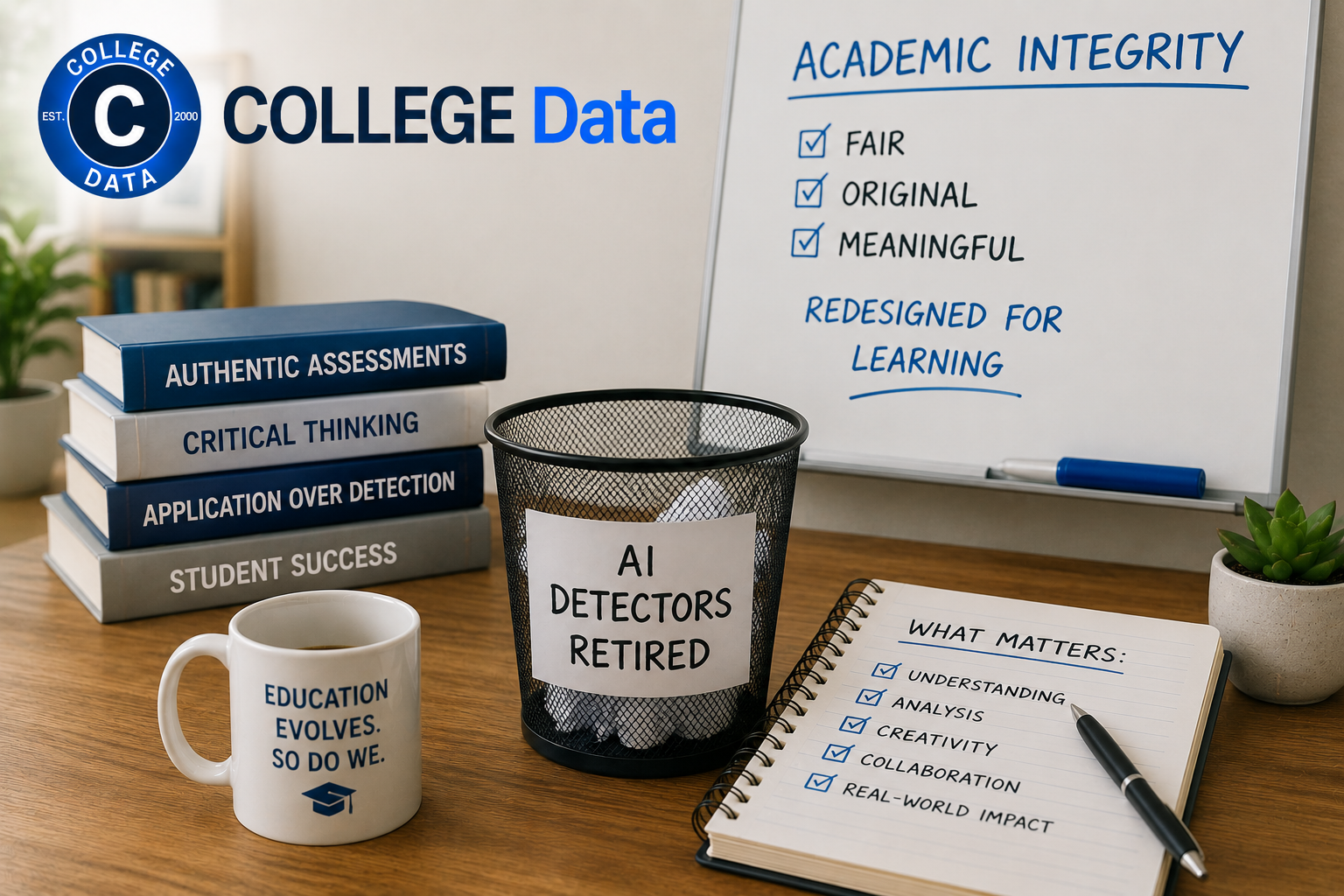
A genuinely significant shift is playing out in how institutions approach academic integrity. Universities are increasingly retiring AI detection tools, the software many institutions adopted quickly in response to generative AI's arrival, in favor of fundamentally redesigned assessment methods. This is not a minor tooling change. It represents institutions acknowledging that AI detection, however appealing as a quick technological fix, has proven unreliable enough that continuing to rely on it creates more genuine risk, false accusations, inconsistent enforcement, eroded student trust, than it resolves.
For provosts, faculty development offices, and academic integrity leadership specifically, this represents a genuine, current shift requiring real institutional attention, not a settled technology question institutions can consider resolved.
AI detection tools were adopted rapidly across higher education as generative AI became widely accessible to students, offering institutions a seemingly straightforward technological answer to a genuinely difficult new challenge. In practice, these tools have proven considerably less reliable than institutions initially hoped, producing both false positives flagging genuine student work as AI-generated and false negatives missing genuinely AI-generated submissions, an accuracy problem serious enough that relying on detection results for academic integrity decisions has created real institutional risk.
False positive cases specifically have generated genuine reputational and legal exposure for institutions, since falsely accusing a student of academic dishonesty based on unreliable detection software carries real consequences for both the student and the institution's credibility, particularly as awareness of these tools' genuine limitations has become more widespread among students, families, and increasingly, institutional legal counsel advising against over-reliance on detection results alone.
Institutions moving away from detection-based enforcement are increasingly redesigning assessments to make AI-assisted academic dishonesty considerably less relevant to how students are actually evaluated, rather than trying to detect and punish AI use after the fact. This includes shifting toward in-class writing components, oral defense of written work, process-based assessment that evaluates a student's actual working and revision process rather than only a final submitted product, and assignment design that genuinely requires the kind of personal reflection or course-specific application AI tools handle less effectively.
"Universities are retiring AI detectors. The week's clearest news item was Inside Higher Ed's report: AI Detectors Are Out, New Assessments Are In."
This redesign work represents genuinely substantial faculty development investment, since redesigning assessment methods across a curriculum requires considerably more sustained effort than simply installing detection software and treating academic integrity as technologically solved. Faculty need genuine training and support to redesign assessments effectively, not just awareness that detection tools are no longer considered a reliable solution.
Institutions still relying primarily on AI detection tools for academic integrity enforcement face genuine, mounting risk as these tools' limitations become more widely understood and as legal and reputational exposure from false accusation cases continues accumulating across higher education generally. This is not a problem institutions can address through incremental adjustment alone. It requires genuine, systematic assessment redesign work that takes real time and sustained faculty development investment to implement effectively across a curriculum.
Institutions moving quickly to invest in this redesign work are positioned to reduce genuine legal and reputational risk while also, in many cases, producing assessment approaches that evaluate genuine student learning more effectively than either traditional take-home assignments vulnerable to AI misuse or detection-based enforcement that has proven unreliable in practice.
Faculty need considerably more than a policy memo announcing that detection tools are being retired. They need genuine, practical guidance on redesigning specific assignment types, professional development sessions working through real redesign examples relevant to their own discipline, and ongoing support as they implement new assessment approaches and encounter genuine practical challenges applying them within their specific course context and student population.
This creates real, near-term demand for faculty development resources specifically focused on AI-era assessment redesign, distinct from generic AI literacy training that does not address the specific practical challenge of redesigning evaluation methods for a discipline and student population faculty already know well. Institutions without dedicated faculty development capacity for this specific challenge may need to build it quickly, given how directly this affects core institutional academic integrity function.
Consider a large introductory course that has historically relied on take-home essay assignments as a primary assessment method, a format genuinely vulnerable to AI misuse and one where detection software had been the institution's primary defense against this specific risk. As the department moves away from AI detection following institutional guidance, the course instructor faces a genuine redesign challenge: how to evaluate student writing and critical thinking effectively at scale, across a section with hundreds of students, without either the take-home essay format's genuine AI vulnerability or the unreliable detection software the department is retiring.
Instructors navigating this redesign successfully are often moving toward a hybrid approach, shorter in-class writing components paired with a take-home component that asks students to apply course concepts to their own specific experience or a case study requiring genuine personal engagement AI tools handle less effectively. This redesign takes real time to develop and pilot effectively, and instructors without dedicated faculty development support attempting this redesign alone, on top of already substantial teaching and research responsibilities, may struggle to implement it as thoughtfully as the challenge genuinely requires.
A genuine risk in this transition is institutions searching for a new technological solution to replace AI detection, rather than accepting that meaningful academic integrity protection in the current environment requires genuine pedagogical redesign rather than another software-based shortcut. Vendors offering a new detection or monitoring technology promising to solve this problem more reliably than previous tools should be evaluated with real skepticism, given how quickly the previous generation of detection tools moved from promising solution to acknowledged liability once real-world accuracy limitations became apparent at scale.
Institutions genuinely learning from this experience should approach any new technological solution to academic integrity with considerably more caution and rigorous, independent accuracy testing before broad institutional adoption than characterized the initial rapid adoption of AI detection tools when generative AI first became widely accessible to students. The lesson from this experience is not that technology cannot play any role in academic integrity, but that technology alone, without genuine underlying assessment design that reduces the actual opportunity and incentive for AI misuse, is unlikely to provide the reliable solution institutions initially hoped detection software would deliver.
Beyond individual assessment redesign, institutions need genuine policy clarity about how academic integrity violations will actually be evaluated and adjudicated in the absence of detection software as a primary evidence source. This requires real coordination between academic integrity offices, faculty governance bodies, and legal counsel to develop policy frameworks that remain fair and defensible without relying on the kind of algorithmic evidence detection tools previously provided, however unreliable that evidence ultimately proved to be in practice.
Institutions without updated policy clarity on this specific question risk genuine inconsistency in how individual faculty members handle suspected academic integrity concerns, some potentially over-relying on subjective judgment without clear institutional guidance, others potentially under-enforcing genuine concerns out of uncertainty about what evidence and process now applies in the absence of the detection tools many faculty had grown accustomed to relying on as a primary reference point.
This is not the only sector navigating a genuine reversal away from a previously adopted solution that has proven less reliable than institutions initially hoped this year. K-12 districts are facing a related communication challenge too, since a new vaccine executive order is confusing parents, putting school nurses caught in the middle. Healthcare organizations can find useful terminology grounding directly too, and Physician Data's glossary offers context for exactly this kind of institutional shift.
Government agencies are managing a related structural disruption too, since New York's new data center moratorium created an entirely new category of government decision-maker almost overnight. And K-12 hiring reflects a related structural pressure too, since new federal loan changes are deepening the teacher shortage right when districts need more candidates, not fewer.
Universities retiring AI detection tools in favor of genuinely redesigned assessment represents institutions acknowledging that a quick technological fix has not held up to sustained scrutiny, and that meaningful academic integrity protection requires genuine curricular investment rather than software alone. Institutions moving quickly to build real faculty development capacity for this redesign work are positioned to reduce genuine institutional risk while producing assessment approaches that evaluate student learning more effectively than the detection-based enforcement most are now moving away from. Given how directly this touches core institutional credibility around academic integrity, institutions treating this redesign as a genuine strategic priority, rather than a lower-stakes technology transition, are likely to navigate this moment considerably more successfully than those still searching for a simpler replacement solution, and those documenting their redesign process thoughtfully now may find themselves genuinely well positioned to share that expertise with peer institutions still working through this same transition.
Ready to reach the faculty development and academic leaders navigating this shift? Build a higher education marketing database, or buy a college email list, with College Data today.




 0
0
POST A COMMENT