

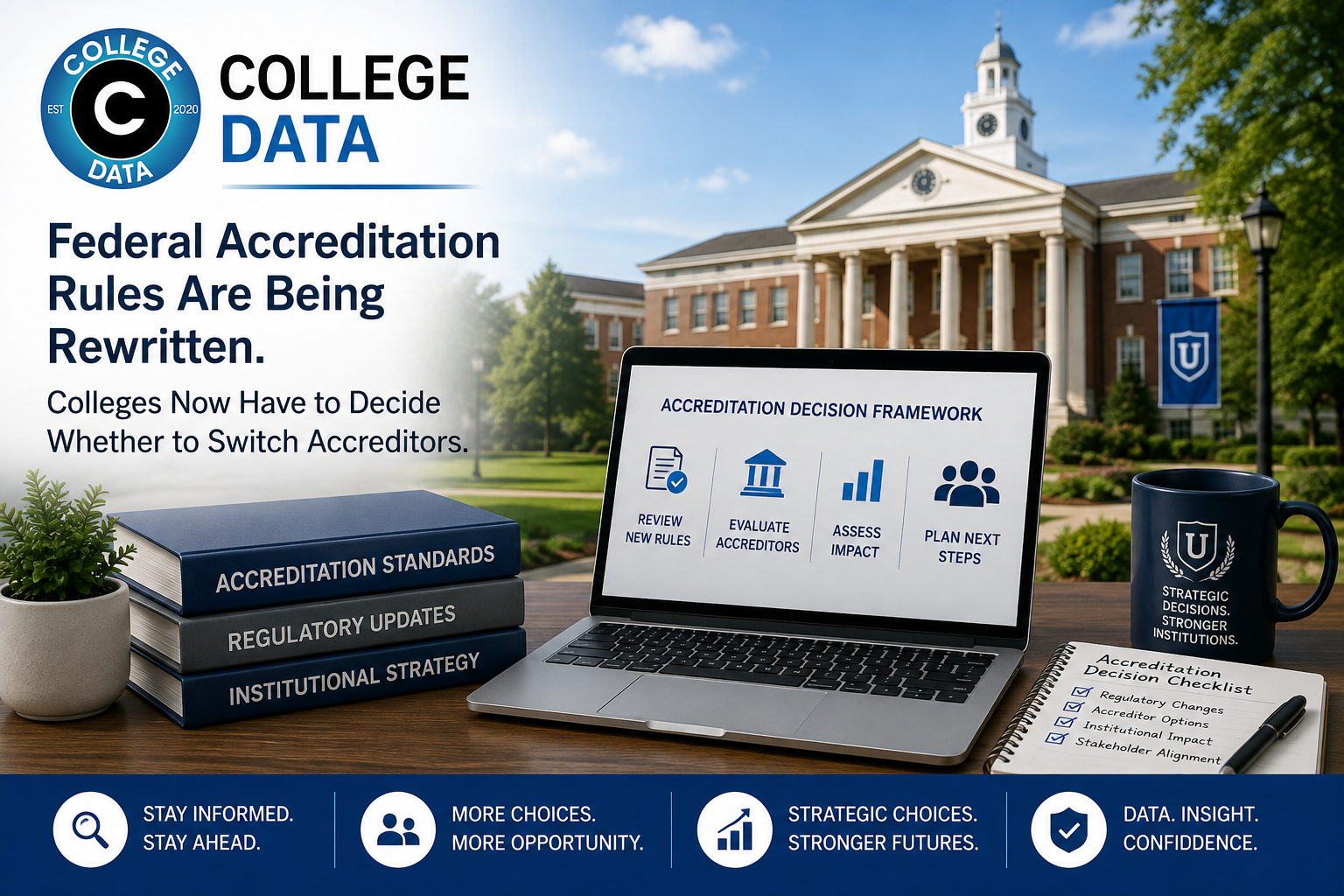
Accreditation has functioned for decades as a relatively fixed, slow-moving relationship between an institution and a single recognized accrediting body. That relationship is now genuinely in motion. The Department of Education's negotiated rulemaking committee on Accreditation, Innovation, and Modernization has reached consensus on a package that dramatically shortens the path for new accreditors to gain federal recognition, opening the door to more competition in a system that has operated with remarkably little of it for a very long time.
For provosts, accreditation liaison officers, and institutional leadership generally, this is not an abstract policy conversation. It creates a genuinely new decision that most institutions have never had to seriously evaluate: whether their current accreditor still represents the best fit, or whether a faster-moving, newly recognized alternative might now be worth considering.
The AIM negotiated rulemaking process reached consensus on provisions that meaningfully shorten and simplify the pathway for new accrediting organizations to achieve federal recognition, a process that has historically taken years and represented a genuine barrier to entry for any organization seeking to compete with the small number of established regional and national accreditors institutions have relied on for generations. Faster recognition means more accreditors entering the market, which means institutions facing an accreditation renewal cycle now have a genuinely different competitive landscape to evaluate than they did even two years ago.
This does not mean every institution needs to consider switching accreditors immediately. It means the option itself is becoming real in a way it was not before, and institutional leadership evaluating an upcoming reaccreditation cycle now has a genuine strategic decision to make that simply did not exist as a practical, near-term option in the recent past, when the entire question of comparative accreditor evaluation was, for most institutions, purely theoretical.
Accreditation decisions have historically been treated as largely administrative, a compliance function handled by an accreditation liaison officer working through an established, familiar relationship with a known accrediting body. This rule change elevates accreditation choice into a genuine strategic decision, one that increasingly involves provosts, presidents, and boards of trustees directly, given the real institutional implications tied to accreditor selection, program approval timelines, and how a given accreditor's standards align with an institution's specific strategic priorities and program mix.
Institutions with significant career-focused or professional program portfolios, where program-level outcomes and employer relationships matter considerably to accreditation standards, may find new, more specialized accreditors genuinely worth evaluating, particularly if a new entrant positions itself around faster review cycles or standards more specifically aligned with workforce-focused program types than a traditional regional accreditor's broader, more generalized framework.
Accreditation liaison officers, who have historically managed a relatively routine, predictable compliance relationship, are now facing a genuinely more complex evaluation function, needing to research and compare accreditor options in a way this role has rarely required before. Provosts and vice presidents of academic affairs are being pulled into accreditation strategy conversations earlier and more substantively than the traditional model required, since accreditor choice now carries real strategic weight extending well beyond routine compliance management.
Boards of trustees, particularly at institutions facing a genuinely open accreditation decision for the first time, are increasingly requiring formal presentations on accreditor options as part of fiduciary oversight, a governance-level engagement with accreditation that most boards have never previously needed to exercise given how settled and unchanging this landscape has traditionally been.
Institutions approaching a reaccreditation cycle in the next several years are the ones facing this decision with the most immediate urgency, since the newly opened competitive landscape means due diligence on accreditor options now genuinely belongs in reaccreditation planning in a way it simply did not before this rule change. Institutions further from their next renewal cycle have more runway to watch how new accreditors actually perform once recognized, but even these institutions benefit from beginning to track this landscape now, rather than starting research from scratch once their own renewal cycle arrives.
This creates real, near-term demand for accreditation consulting services, comparative accreditor research and evaluation tools, and governance support helping boards and institutional leadership navigate a genuinely new category of strategic decision most have never had to make before, at least not with real, viable alternatives actually available to weigh against an incumbent relationship.
New entrants seeking federal recognition under this faster pathway face their own genuine challenge: building institutional trust and a track record in a market where incumbent accreditors have decades of established relationships and reputational weight. New accreditors succeeding in this environment will need genuine marketing and relationship-building infrastructure reaching the exact institutional leaders now facing this evaluation decision, provosts, accreditation liaison officers, and presidents specifically, rather than relying on institutions simply discovering them organically through the recognition process alone.
This represents a genuinely new category of buyer within higher education marketing broadly: accrediting organizations themselves, now facing a competitive landscape requiring real outreach and relationship-building infrastructure that established accreditors, operating for decades without meaningful competition, have never previously needed to develop.
Consider a mid-size regional university approaching reaccreditation within the next two years, currently affiliated with a regional accreditor it has worked with for decades. Historically, this institution's accreditation liaison officer would simply begin preparing the standard self-study and site visit materials, with essentially no consideration of alternatives, since none genuinely existed in practical terms. Under the new landscape, that same institution now has a real decision to make: continue with the familiar accreditor, or seriously evaluate whether a newly recognized alternative, potentially one with a faster review cycle or standards more closely aligned with the institution's specific program mix, might actually serve the institution better going forward.
This is not a decision most accreditation liaison officers have the institutional experience or comparative research infrastructure to make confidently on their own. It increasingly requires input from academic affairs leadership, financial planning around potential transition costs, and genuine board-level engagement given the strategic weight of the decision. Institutions without established processes for this kind of comparative evaluation are having to build that capability essentially from scratch, often under real time pressure given how quickly a reaccreditation cycle can arrive once the clock starts running.
The most obvious selling point for a newly recognized accreditor is a faster review and recognition timeline, but institutions evaluating genuine alternatives should look considerably beyond just process speed. Standards alignment with an institution's actual program mix, the accreditor's own reputation and credibility with employers and transfer institutions, and the depth of support offered during a transition all matter enormously and are much harder to evaluate quickly than a simple timeline comparison.
New entrants competing purely on speed risk attracting institutions that later discover the faster process came with real tradeoffs in standards rigor or industry recognition, a mismatch that could ultimately cost more than it saves once employers, transfer institutions, or students themselves begin questioning the credibility of a degree tied to a newer, less established accreditor. Institutions evaluating this decision should weigh long-term credibility as heavily as near-term convenience, since accreditation ultimately exists to signal quality and trust to exactly these external audiences.
Most boards of trustees have never needed genuine expertise in comparative accreditor evaluation, since the landscape has been stable enough that accreditation rarely required board-level strategic attention beyond routine oversight of the reaccreditation timeline itself. This rule change is forcing a real governance conversation many boards are not yet equipped to have well, lacking both the comparative information and the internal expertise to evaluate accreditor alternatives with genuine rigor.
Institutions serious about navigating this well should be building board education into their reaccreditation planning now, well before an actual decision point arrives, rather than presenting trustees with a rushed, high-stakes choice during an already time-pressured reaccreditation cycle. This is a genuine opportunity for consulting and advisory services specifically built around helping institutional governance bodies understand and evaluate this newly opened landscape with appropriate rigor.
Institutions do not need to launch a full comparative accreditor evaluation immediately to begin preparing well for this shift. A practical first step is simply building internal awareness of the new competitive landscape, ensuring the accreditation liaison officer, academic affairs leadership, and at least a subset of board members understand that genuine alternatives now exist and are likely to expand further as more accreditors achieve recognition under the faster pathway. This awareness-building step costs relatively little and creates the internal foundation needed for a more substantive evaluation once an institution's own reaccreditation cycle actually approaches.
Institutions that skip this awareness-building step and instead wait until reaccreditation is imminent to first learn that alternatives exist are likely to face a rushed, poorly informed decision process precisely when the stakes are highest and the time pressure is most acute.
This is not the only sector where a previously stable, slow-moving institutional relationship is suddenly facing real competitive pressure. K-12 districts are navigating their own version of a suddenly opened decision landscape, since cybersecurity responsibility is being redistributed to a facility management role that has never previously owned this function, a comparable shift in who owns a previously settled institutional relationship.
Healthcare organizations are facing a related wave of institutional distress and reorganization too, since physician practice bankruptcies just hit their highest level since 2019, creating real M&A and restructuring decisions institutions have not had to navigate at this volume before. Government agencies face a similarly disrupted procurement landscape, since new AI-specific requirements and cooperative contract mandates are reshaping who approves a public-sector technology purchase. And K-12 hiring reflects a related institutional pressure too, since Indiana's elimination of teacher preparation programs under a state productivity mandate is forcing districts to reconsider settled assumptions about their traditional hiring pipeline.
Accreditation has been one of the most stable, least competitive relationships in higher education for decades, and that stability is genuinely ending. Institutions approaching a reaccreditation cycle now face a real strategic decision that did not meaningfully exist before this rule change, and the institutional leaders navigating this evaluation, provosts, accreditation liaison officers, board members, represent a genuinely new category of decision-maker vendors serving higher education need to understand and reach accurately. The institutions that build genuine comparative evaluation capability now, well ahead of their own reaccreditation deadline, will be the ones making this decision from real strength rather than under pressure once the clock has already started running.
Ready to reach the institutional leaders navigating this accreditation shift? Build a higher education marketing database, or buy a college email list, with College Data today.




 0
0
POST A COMMENT