

For years, micro-credentials were presented as the thing that was going to disrupt higher education someday. Someday has arrived.
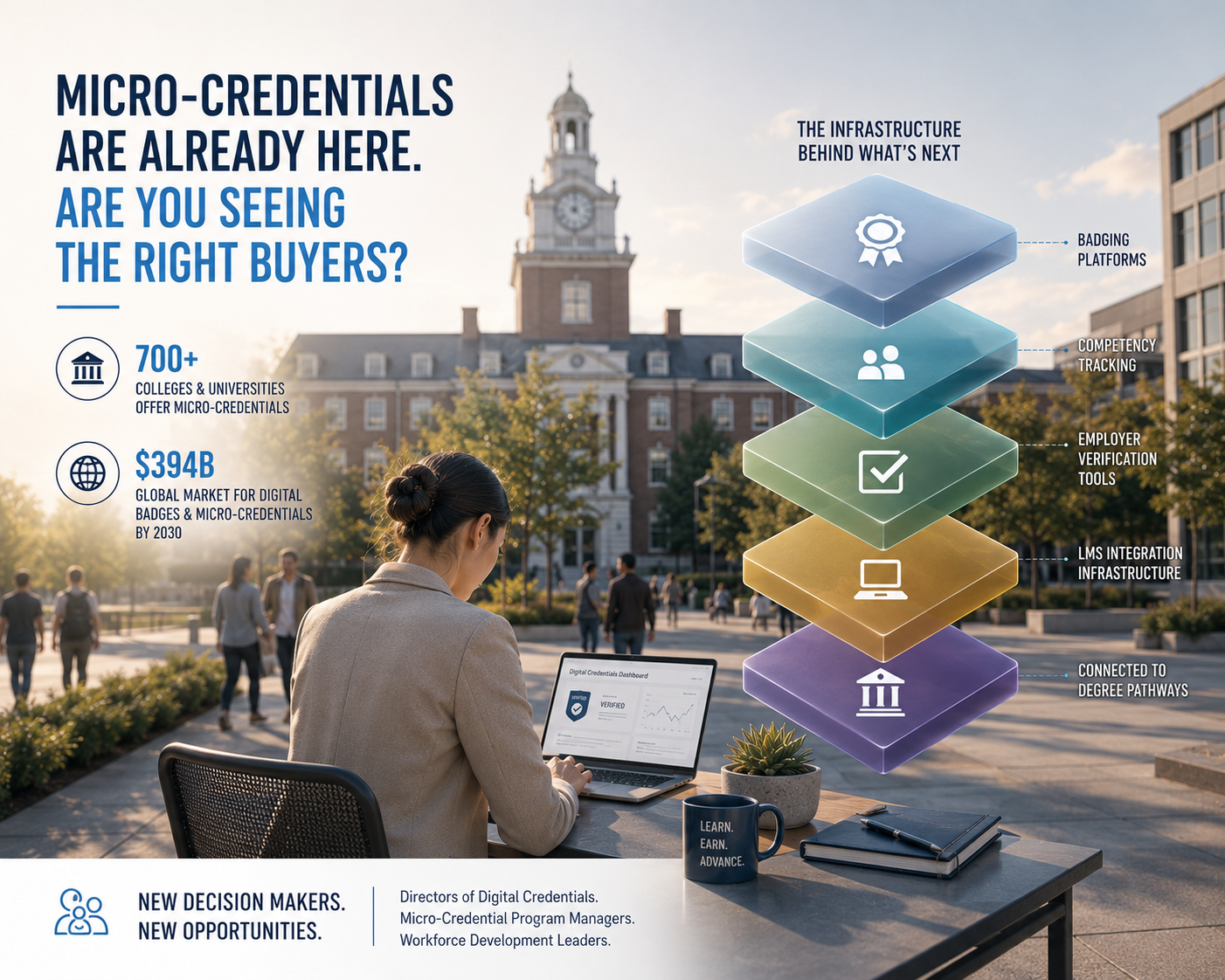
More than 700 colleges and universities now offer some form of stackable micro-credential. The global market for digital badges and short-form credentials is projected to reach $394 billion by 2030. Employers including Google, IBM, Amazon, and Salesforce have built their own credential programs and are actively signaling to hiring managers that specific micro-credentials carry real weight in candidate evaluation. LinkedIn has added a credential verification feature that gives digital badges the kind of visibility on professional profiles that makes them genuinely useful rather than decorative.
The students have noticed. Enrollment in micro-credential programs has grown significantly at institutions that have made the infrastructure investment to offer them at scale. Community colleges, regional universities, and continuing education divisions at larger institutions are seeing meaningful demand from working adults who want a specific, demonstrable skill credential without the time and cost of a full degree program.
For higher education vendors, all of this adds up to a purchasing wave that has been building for years and is now clearly in the mainstream. The technology that makes micro-credential programs operationally viable -- digital badging platforms, competency tracking systems, employer verification tools, LMS integration infrastructure, and the credential registry systems that make badges portable and recognizable across employers -- is in active evaluation at hundreds of institutions right now.
The problem is who is doing the evaluating. Most college mailing lists and university email lists are configured to reach admissions directors, registrars, academic deans, and technology administrators. The people driving micro-credential infrastructure purchasing have different titles. And at many institutions they sit in parts of the organization that most college contact databases have never mapped as primary purchasing authorities.
The employers did it. That is the short answer.
When Google launched its Career Certificates program in 2020, the company did something that higher education had never fully experienced before: a major employer publicly stated that its own credential, obtainable in months rather than years, was sufficient qualification for specific jobs that had previously required a four-year degree. Google went further and committed to treating its certificates as equivalent to a bachelor's degree for hiring purposes within the company.
IBM followed with its SkillsBuild platform. Amazon launched AWS certifications that became de facto requirements for cloud computing roles. Salesforce built the Trailhead credential system that is now recognized by employers across the technology sector. The message from the employer community was unmistakable: we care about what you can do, and we are willing to validate what you can do through credentials that are not issued by accredited universities.
Higher education had two choices. Compete with employer-issued credentials by building its own micro-credential offerings that are faster, more flexible, and more directly connected to employer skill requirements than traditional degree programs. Or ignore the shift and lose the working adult and continuing education market to employers, boot camps, and online learning platforms that were already moving faster.
Most of the institutions that have responded well are the ones that recognized micro-credentials not as a threat to their degree programs but as a complement to them. A student who earns a micro-credential in data analytics at a community college can stack that credential toward a degree program later. An employer who helps design the competency framework for a university's cybersecurity micro-credential gets a pipeline of graduates with skills the employer actually needs. When the incentives align, micro-credential programs grow quickly.
The government dimension of this growth matters for vendors. The workforce development funding that flows through WIOA grants and the Perkins Act has increasingly been directed toward programs that produce specific, employer-recognized credentials rather than traditional academic degrees. State workforce agencies and workforce development boards are actively funding the micro-credential programs that produce the fastest employment outcomes for grant-eligible populations. Civic Data's research on how state workforce development funding is flowing into community colleges and employer-connected programs documents how the government contact layer of the micro-credential market -- state workforce agency officials and workforce development board directors -- are co-funders and co-evaluators for the same infrastructure that higher education administrators are building from the institutional side. Vendors with college mailing lists alongside civic mailing lists from Civic Data are positioned to reach both sides of this purchasing conversation.
This is the contact that most college mailing lists do not have. The Director of Digital Credentials is a role that has emerged at institutions that have made micro-credentialing a strategic priority rather than a side project of the continuing education office. This administrator is responsible for the technical infrastructure, the badging platform, the competency framework design, the employer partnership relationships, and the student-facing communication about what a digital credential means and how to use it. They evaluate and select the badging platforms, credential registry systems, and verification tools that make the program operationally real. They are a primary purchasing authority with a dedicated budget -- and most university email lists treat them as a subcategory of continuing education or IT rather than a standalone purchasing contact.
The Dean of Continuing Education or Workforce Development is the executive sponsor for micro-credential programs at many institutions, particularly community colleges and regional universities where workforce development has been elevated to a strategic institutional priority. This contact carries purchasing authority for the full infrastructure stack that micro-credential programs require -- not just the badging platform but the LMS integration, the employer partnership management tools, the prior learning assessment infrastructure, and the outcome tracking systems that satisfy grant reporting requirements. College mailing lists that treat the Workforce Development Dean as a secondary contact behind traditional academic leadership are systematically missing the purchasing sponsor for one of the fastest-growing higher education technology categories.
As micro-credentials become more common, the question of how they are recorded, verified, and made portable has become a significant operational challenge. The Registrar's Office -- traditionally responsible for academic transcripts and degree verification -- is being pulled into the micro-credential infrastructure conversation because employers and graduate programs want to verify digital badges through the same authoritative source they use to verify degrees. The Registrar or Credential Verification Official at institutions building comprehensive micro-credential programs is a co-evaluator for the credential registry and verification platform decisions that determine whether a digital badge is trusted by the employers it is supposed to impress.
At institutions that have elevated micro-credentialing to a board-level strategic initiative, the Provost or Chief Academic Officer is the executive authorizing the infrastructure investment. This is not the same CAO who is managing faculty governance and curriculum approval for traditional degree programs. This is an academic executive who has made a strategic commitment to non-degree credential offerings and who is driving the budget decisions that make the infrastructure real. University email lists that segment Provosts at institutions in active micro-credential build-out as distinct, high-urgency purchasing contacts are reaching a different and more valuable contact than the general CAO population.
Digital badging platforms are the core purchasing category. These are the systems that issue, store, display, and verify digital credentials in formats that are portable across platforms and recognizable to employers. The Open Badges standard, developed by IMS Global, has become the dominant technical framework for interoperable digital credentials, and most institutional badging platforms now support it. The evaluation process for badging platforms involves the Director of Digital Credentials, the Registrar, and the IT team that manages LMS integration -- a cross-functional buying committee that requires college mailing lists capable of reaching all three contact types.
Competency framework and curriculum mapping tools are a purchasing category that most college mailing lists have not associated with micro-credential programs. Before an institution can issue a meaningful digital credential, it needs to define what competencies the credential certifies, map those competencies to employer skill requirements, align them with existing curriculum, and document the evidence that a student has demonstrated mastery. The technology that supports this process -- competency management platforms, curriculum mapping tools, and the outcome tracking infrastructure that connects learning activities to credential issuance -- is evaluated primarily by the Director of Digital Credentials and the academic leadership of the programs offering the credentials.
Employer partnership and verification platforms are a growing priority as micro-credential programs become more sophisticated. The credential only has value if employers trust it, and employers trust credentials most when they can verify them instantly, understand exactly what competencies they certify, and ideally have had input into the competency framework the credential is based on. Employer partnership management tools and credential verification APIs are becoming standard components of mature micro-credential programs. The purchasing conversation for these tools connects to what K12 Data's research on how dual enrollment programs are building employer-connected pathways has documented -- in both markets, the institutions that have built formal employer relationships into their credentialing programs produce graduates who are more attractive to those employers than those whose credentials exist in isolation from the hiring market.
LMS integration and prior learning assessment infrastructure connect the micro-credential ecosystem to the broader academic technology stack. Students who earn micro-credentials through non-traditional pathways -- workplace experience, independent study, employer training programs -- need prior learning assessment processes that evaluate and credit what they already know. The technology that supports prior learning assessment, and the LMS integration that makes micro-credential coursework visible within the same student experience as traditional courses, is purchased by IT leadership and the Director of Digital Credentials in collaboration with academic affairs. The integration challenge is similar to what College Data's research on the FAFSA crisis and how enrollment technology rebuilds required cross-functional buying committees documented -- in both cases, the technology decision spans multiple departments and requires contact data that reaches the full buying committee rather than a single decision-maker.
• Add Director of Digital Credentials and Micro-Credential Program Manager as distinct contact categories. These are not subcategories of continuing education or IT. They are dedicated purchasing authorities for a technology infrastructure that is distinct from traditional academic technology and from general continuing education platforms.
• Segment by institutional commitment to micro-credentialing. Institutions that have named digital credentials as a strategic priority in their academic plans, created dedicated leadership roles for it, or announced partnerships with major employers for credential co-development are in the highest urgency purchasing mode for the infrastructure. College mailing lists that identify these institutions through their public announcements are reaching the most active buyers first.
• Include the Registrar as a co-evaluator for badging platform purchases. The credential verification function that the Registrar controls is a required component of any micro-credential infrastructure that employers are expected to trust. College administrator email lists that map the Registrar as a co-evaluator alongside the Director of Digital Credentials are providing full buying committee coverage for this purchasing decision.
• Connect workforce development grant status to purchasing urgency. Institutions receiving WIOA or Perkins Act funding for micro-credential programs are operating under grant compliance timelines that create purchasing urgency for the technology that tracks outcomes and supports reporting. Higher education mailing lists that incorporate workforce development grant status are identifying the institutions with both the funding and the compliance deadline urgency to purchase quickly.
The micro-credential market is not coming. It is here, it is growing, and it has real money behind it from employers, from students, and from government workforce development programs. The technology infrastructure that makes it work is being purchased right now at hundreds of institutions by Directors of Digital Credentials, Workforce Development Deans, and Registrars whose names are not in most college mailing lists.
The vendors who build the college mailing lists and university email lists that include these contacts as distinct, high-priority purchasing tiers are entering a market where the urgency is real, the buyer is ready, and the competition has not yet shown up. That window does not stay open forever.
K12 Data -- Build a List | Pricing | Blog College Data -- Build a List | Pricing | Blog Physician Data -- Build a List | Blog Civic Data -- Build a List | Blog




 0
0
POST A COMMENT