

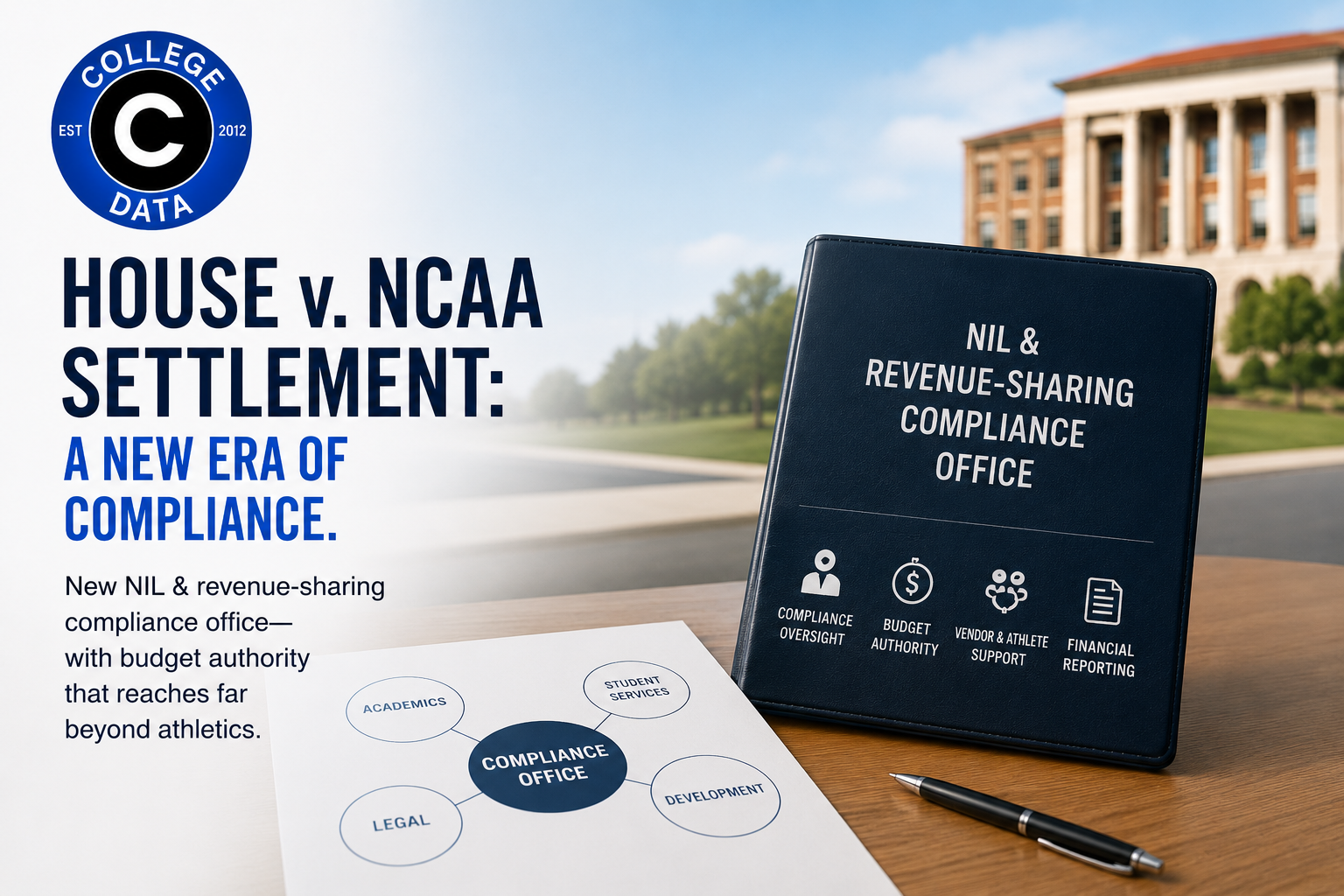
NIL and Revenue-Sharing Compliance Has Become the Fastest-Growing New Budget Line on Campus, and It Reaches Well Beyond Athletics
On June 6, 2025, a federal judge granted final approval to the House v. NCAA settlement, and college athletics changed more in the following twelve months than in the previous twenty years combined. For the first time, Division I institutions can pay their athletes directly, up to a cap that opened at roughly $20.5 million per school for the 2025-26 academic year and is scheduled to climb toward $32 to $33 million by the mid-2030s. Roughly 82 percent of Division I programs opted into the new framework by last summer's deadline.
That single legal change did something most coverage of the settlement has missed. It created an entirely new, centrally administered, and heavily funded compliance function at nearly every major athletic department in the country, and that function is hiring, buying software, and building processes right now in ways most college mailing lists have not caught up to.
Before the settlement, NIL activity ran through a loose, largely unregulated network of booster-funded collectives paying athletes for endorsements with minimal institutional oversight. The settlement replaced that informal system with centralized enforcement through the College Sports Commission, which now administers two platforms every participating school must actively manage: NIL Go, the clearinghouse where every third-party NIL deal over $600 must be submitted for review, and the College Athlete Payment System, the reporting portal for the revenue-sharing payments schools make directly. On January 9, 2026, the College Sports Commission sent a formal warning letter to member institutions over compliance concerns, signaling that this is not a symbolic reporting requirement but an actively enforced one. A joint statement from the presidents of Arizona, Georgia, Virginia Tech, and Washington in mid-January urged institutions to fully commit to the participation agreement despite its flaws, which tells you how seriously athletic leadership is now treating this function.
Clemson has been explicit about what this looks like organizationally, describing a centralized "front office" inside its athletic department responsible for contract details, reporting, allocation strategy, enforcement, and NIL and agency rights, with each individual sports program acting as a spoke off that central hub. That is not a compliance officer added to an existing job description. It is a new department.
The financial stakes have pulled other parts of the institution directly into this compliance structure in ways a vendor focused narrowly on athletics will miss entirely. Scholarship limits were eliminated and replaced with roster limits under the settlement, which independent analysis suggests could increase the value of athletic scholarships awarded by an average of $10 million per school across FBS public universities, with some schools seeing increases over $20 million. That is university-wide financial aid and budget office exposure, not an athletic department line item. Title IX compliance has become a live and unresolved question as institutions design revenue-sharing allocation formulas, with female athletes already challenging aspects of the settlement's distribution in federal appeals court. General counsel's office involvement in NIL and revenue-sharing contract enforcement escalated sharply after Duke sought, and was denied, a temporary restraining order in January 2026 trying to block a departing quarterback from entering the transfer portal, a case that is now shaping how every institution's legal office thinks about athlete contract enforceability. And on April 3, 2026, a presidential executive order titled "Urgent National Action to Save College Sports" tied athletic department compliance practices to federal grant and contract eligibility for the entire institution, effective August 1, 2026, which means a university's central grants and contracts office now has a direct stake in how its athletic department handles NIL.
Nothing in the House settlement dictates how a school divides its revenue-sharing pool across sports, which has produced wide variation that matters enormously for anyone selling technology or services into athletics. At Texas Tech, roughly 74 percent of the school's revenue-sharing allocation went to football and another 17 to 18 percent to men's basketball, leaving a thin slice for every other program on campus. That concentration pattern is repeating at most Power Four schools, which means the cap management, contract administration, and compliance software this new office is buying is being evaluated primarily through the lens of two sports, even though the office itself has authority over the entire athletic department's compliance posture. A vendor pitching a platform built to handle every sport equally is solving a problem this buyer does not actually have; a vendor who understands that football and basketball drive the purchasing urgency, while the remaining sports are a secondary consideration, will have a much more productive first conversation.
Third-party NIL activity, separate from institutional revenue sharing, remains a live and largely unresolved compliance gap. The College Sports Commission had cleared only about $242 million in third-party deals through its NIL Go portal as of May 2026, a figure analysts believe represents a small fraction of the roughly $500 million in third-party NIL activity estimated in basketball alone, with football likely representing at least double that amount. That gap between reported and actual NIL activity is precisely why the CSC's January 2026 warning letter carried real weight, and it is why compliance officers inside this new office are actively shopping for reporting and documentation tools that can help them demonstrate good-faith compliance even in a system where actual dollar flows remain difficult to fully track.
The single highest-leverage new title created by the settlement is the athletics general manager or Assistant AD for Revenue Share, a role that did not meaningfully exist before 2025 and now controls cap management, allocation strategy across sports, and the software stack used to track it. This contact owns a genuinely new and well-funded budget with essentially no legacy vendor relationships attached to it yet.
Below the general manager sits a growing compliance staff responsible for NIL Go submissions, fair-market-value documentation, and CAPS reporting, all of which represents a live and growing software and services purchasing need distinct from the traditional NCAA compliance office that existed before the settlement.
With contract enforceability now an active legal battleground and a federal executive order tying compliance to institution-wide funding eligibility, general counsel's office has become a genuine stakeholder in athletic department technology and process decisions, a contact most college administrator email lists have never connected to athletics purchasing at all.
This is the same pattern of structural pressure creating brand new, well-funded administrative roles that K12 Data has documented in its research on how the four-day school week forces districts to create entirely new operations positions almost overnight. The sports medicine and athletic training staffing growth running alongside this compliance buildout parallels the practice-level administrative expansion Physician Data has tracked in independent physician groups responding to their own regulatory pressure. The federal executive order's approach of tying institutional compliance to funding eligibility is the same lever Civic Data has watched state and federal government increasingly use to shape local and institutional behavior through funding conditions rather than direct mandates. And the sheer volume of new, specialized administrative hiring this creates, general managers, compliance officers, and cap analysts, all needing to be filled on a compressed timeline, is exactly the kind of hiring wave K12 Talent's research on administrative hiring season has documented playing out across education more broadly.
● Build athletics general manager, Assistant AD for Revenue Share, and NIL compliance officer into your university email list as distinct, high-priority contact titles separate from your existing athletic director and compliance office contacts.
● Identify institutions that opted into the settlement's revenue-sharing framework as a distinct, higher-urgency segment, since roughly one in five Division I programs did not opt in and are not building this new function at all.
● Watch the August 1, 2026 executive order effective date closely, since it may pull general counsel and institutional grants offices into athletic compliance purchasing decisions for the first time.
● Develop messaging that speaks to cap management, allocation tracking, and CAPS reporting specifically, since generic athletic department technology pitches do not address what this new buyer is actually trying to solve.
The August 1, 2026 executive order deadline is the single most important date on this new office's calendar, and it is worth watching closely regardless of whether the order ultimately survives the legal challenges it is almost certain to face. Institutions are not waiting to find out. General counsel's offices at schools with significant federal research funding are already reviewing NIL and revenue-sharing practices against the order's "fraudulent NIL scheme" standard, which flags any arrangement paying above fair market value for NIL services connected to an athlete's enrollment decision. That review process alone is generating demand for valuation documentation and fair-market-value benchmarking tools that barely existed as a product category a year ago. Whatever the order's ultimate legal fate, the compliance expectations it has already established are shaping how athletic departments, general counsel offices, and revenue-sharing staff operate for the foreseeable future, and vendors who can speak fluently to that standard right now have a real window before the market catches up.
The House v. NCAA settlement did not just change how college athletes get paid. It created a new, centrally funded, and actively enforced compliance department at nearly every major athletic program in the country, staffed by titles that barely existed eighteen months ago and backed by budget authority that reaches into financial aid, Title IX compliance, general counsel, and institutional grants offices. Vendors who have identified the general manager and NIL compliance officer as distinct purchasing contacts are reaching a genuinely new market with almost no legacy vendor relationships in place. Vendors still routing every athletics conversation through the athletic director's office are missing the fastest-growing new budget line on campus.
K12 Data -- Build a List | Pricing | Blog College Data -- Build a List | Pricing | Blog Physician Data -- Build a List | Blog Civic Data -- Build a List | Blog K12 Talent -- Post a Job | Search Jobs | Blog




 0
0
POST A COMMENT