

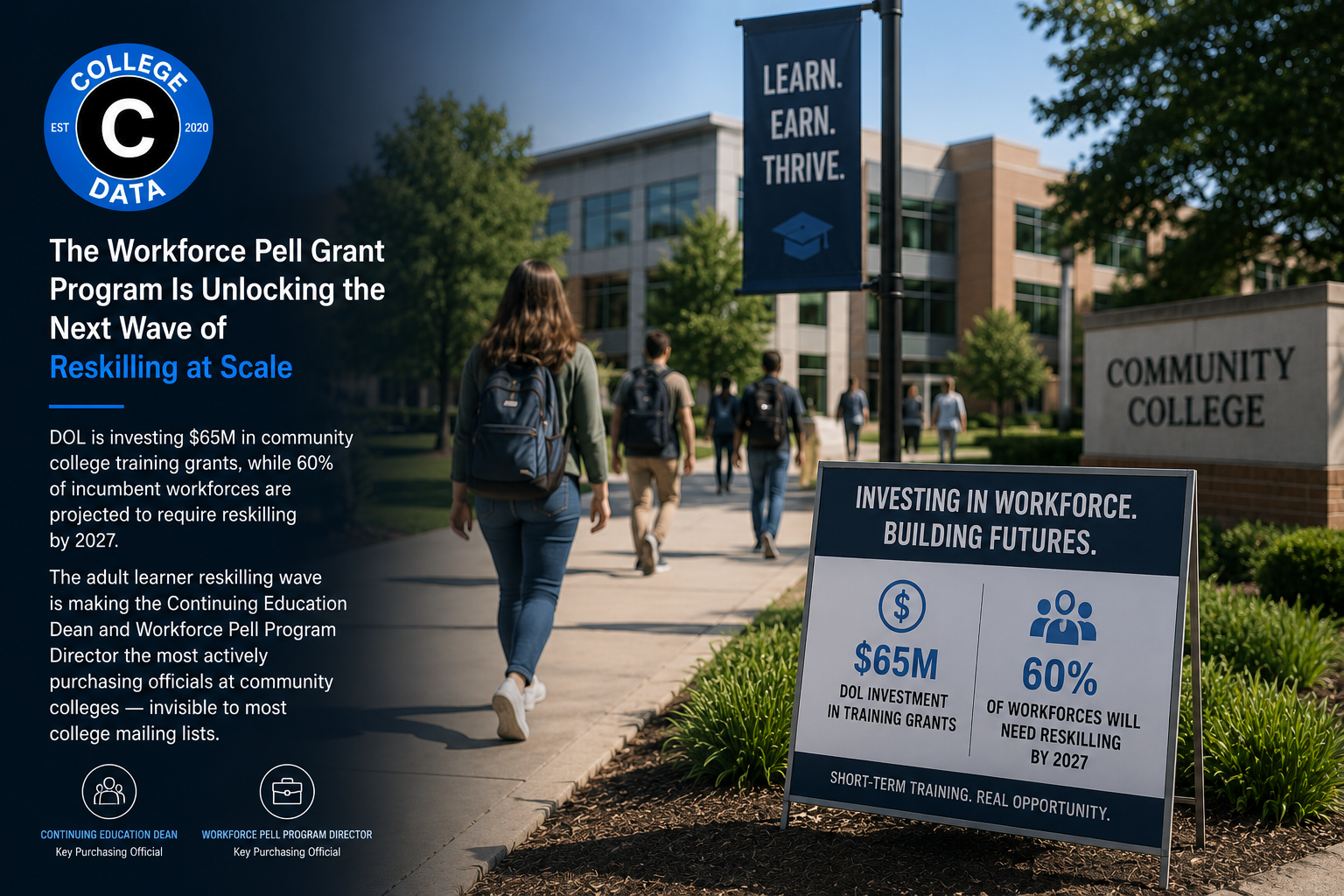
There is a transformation underway in higher education that is generating more active purchasing conversations per institutional contact than anything else happening in the market in 2026 — and it is happening in the corner of the institutional org chart that most college mailing lists, university email lists, and higher education marketing data strategies have always treated as a lower priority than academic affairs and enrollment management.
The adult learner reskilling wave, powered by the newly authorized Workforce Pell Grant program and $65 million in Department of Labor grants specifically targeted at community college workforce training programs, has elevated Continuing Education Deans, Workforce Pell Program Directors, and non-credit program administrators from support function contacts to primary, high-urgency purchasing authorities for an expanding range of technology, curriculum, credentialing, and employer partnership platforms.
The scale of the underlying market shift is significant. Employers project that 60 percent of their incumbent workforce will require reskilling or upskilling by 2027 — accelerated by AI adoption that is changing the task composition of jobs faster than traditional credential programs can respond. The 2.7 million adults who left college without completing a credential — potential completers who are eligible for credentials based on credits already earned — represent a massive, identified re-enrollment opportunity that community colleges and regional comprehensives are actively building programs to serve. And the Workforce Pell Grant authorization, establishing federal financial aid for short-term, high-quality career education programs, has created an entirely new funding mechanism that is generating program development, technology procurement, and employer partnership purchasing on compressed timelines driven by implementation urgency.
The administrators driving all of this purchasing are almost entirely absent from the college mailing lists and university email lists that most higher education vendors are using to reach institutional buyers. The Continuing Education Dean who is building the Workforce Pell program portfolio. The Workforce Development Director who is managing the employer partnership relationships that validate program alignment. The Credit for Prior Learning Coordinator who is developing the assessment infrastructure that enables adults to convert work experience into credential credits. The Non-Credit Program Administrator who is designing the stackable pathway architecture that allows adult learners to build credentials incrementally. These contacts are the primary buyers for the fastest-growing purchasing categories in higher education — and they are systematically absent from college administrator email lists built around academic affairs and traditional enrollment management contacts.
The foundational analysis of how higher education's purchasing authority map has already been shifting away from traditional contacts is documented in Why Every Vendor Targeting Higher Education Is Probably Reaching the Wrong Person — the most direct treatment of why standard college mailing list targeting strategies consistently miss the actual decision-makers at institutions undergoing structural change. For how workforce alignment has become the organizing framework for institutional purchasing authority, see Why Universities Are Quietly Rebuilding Themselves Around Workforce Alignment.
The Workforce Pell Grant — authorized through the One Big Beautiful Bill Act and now in active implementation — represents the most significant expansion of federal financial aid since the original Pell Grant program. By extending Pell eligibility to short-term, high-quality career education programs at community colleges, it has done something that decades of workforce development policy could not: aligned federal financial aid incentives with employer-validated, short-duration credential programs.
The implementation timeline is generating immediate purchasing pressure. The Department of Labor's sixth round of Strengthening Community College Training Grants — $65 million targeted specifically at programs seeking Workforce Pell eligibility — is available in awards up to $11 million, with funding emphasis on applicants developing integrated, learner-centered, industry-aligned state-level data systems. Community colleges that want to participate in Workforce Pell must demonstrate outcomes tracking infrastructure, program quality validation mechanisms, and employer partnership documentation that most continuing education operations were not built to produce.
That infrastructure gap is generating purchasing. Program management platforms for Workforce Pell eligible programs. Outcomes tracking and labor market alignment data systems. Employer partnership management tools. Credential issuance and digital badging infrastructure for stackable certificates. Credit for Prior Learning assessment platforms. Learning management systems designed for non-credit and short-term programs that operate on different schedules and delivery models than traditional credit programs.
The Trump administration's explicit designation of community colleges as engines of economic growth — a proclamation that designated April 2026 as National Community College Month and called on employers and community leaders to champion community college workforce development — has added policy tailwind to an already-accelerating trend. Connecting workforce development programs with improved performance measurement systems to prepare the labor force for an AI-driven economy is now explicitly a federal priority, channeling political and financial support into the institutional programs that the Continuing Education Dean and Workforce Pell Program Director are running.
The K-12 connection to the adult learner reskilling wave is significant and frequently underappreciated. The CTE programs and dual enrollment pathways that K-12 districts are expanding are feeding directly into the community college workforce programs that Workforce Pell is designed to serve — creating a K-14 pipeline that organizations with both school mailing lists from K12 Data and college mailing lists from College Data are uniquely positioned to reach end-to-end. Build a K-12 list | K12 Data blog.
The adult learner reskilling wave has created a distinct tier of purchasing authority in higher education that operates largely independently of the academic affairs and traditional enrollment management structures that most college mailing lists were designed to reach.
Continuing Education Deans and VP-level Workforce Development Leadership. The highest-ranking contact in the adult learner reskilling purchasing ecosystem. These officials hold budget authority for the platforms, partnerships, and programs that serve non-traditional adult learners — and in 2026 they are managing program development timelines driven by Workforce Pell implementation urgency rather than the standard academic calendar cycles that govern curriculum decisions in academic affairs. A college mailing list that does not include Continuing Education Deans and VP-level workforce development contacts as primary, executive-tier outreach targets is missing the budget holders for the fastest-growing new purchasing category in higher education.
Workforce Pell Program Directors and Grant Implementation Leads. The operational contacts managing Workforce Pell program development and DOL grant implementation. These administrators are purchasing the outcomes tracking systems, program quality documentation platforms, and employer partnership management tools that Workforce Pell compliance requires — often on compressed timelines driven by grant award and implementation deadlines. They are new roles at most institutions, created specifically in response to Workforce Pell authorization, and entirely absent from college administrator email lists compiled before the authorization.
Credit for Prior Learning Coordinators and Assessment Directors. Adult learners returning to college bring work experience, military credentials, and professional certifications that can be converted to academic credit through Credit for Prior Learning assessment — dramatically reducing the time and cost required to complete a credential. CPL Coordinators are purchasing assessment platform technology, prior learning portfolio tools, and industry credential equivalency databases. These contacts exist at most community colleges and regional comprehensives but are systematically absent from university marketing lists built around traditional academic and enrollment management contacts.
Non-Credit Program Administrators and Continuing Education Instructional Design Directors. The operational infrastructure of continuing education programs — scheduling, curriculum development, delivery platform selection, student services design for working adult schedules — is managed by administrators who sit outside the academic affairs hierarchy at most institutions. These contacts hold purchasing authority for LMS platforms configured for non-credit delivery, scheduling systems designed for adult learner flexibility, and student support technology for learners who are balancing education with full-time employment and caregiving responsibilities.
Employer Partnership and Industry Relations Directors. The workforce alignment mandate requires that programs demonstrate employer validation — which means that the administrators managing employer relationships at community colleges and regional comprehensives have become purchasing co-evaluators for any platform that supports employer-institution partnerships. CRM systems configured for employer relationship management. Employer advisory board coordination tools. Apprenticeship and work-based learning compliance platforms. These are vendor categories that most college mailing lists have never specifically mapped to employer relations contacts.
The complete analysis of how new administrative roles created by workforce alignment are reshaping the higher education purchasing map is documented in Why Higher Education Email Lists Must Reflect Workforce Alignment and Functional Authority — the most comprehensive treatment of how to build college administrator email lists that reflect the actual 2026 institutional decision-making structure.
Outcomes tracking and labor market alignment platforms. Workforce Pell compliance requires that institutions demonstrate program alignment with labor market outcomes — which means investing in labor market data systems, graduate earnings tracking platforms, and program performance analytics tools that compare completion rates, employment outcomes, and wage gains against program cost and duration. These are purchasing conversations driven by Continuing Education Deans, Workforce Pell Program Directors, and institutional research contacts working in coordination — a multi-contact committee that most college email lists are not structured to reach simultaneously.
Short-term and non-credit LMS platforms. Traditional LMS platforms were designed for semester-length, credit-bearing courses with fixed enrollment periods, persistent gradebooks, and academic calendar pacing. Non-credit and short-term Workforce Pell programs operate on completely different timelines — two-week boot camps, eight-week certificate programs, evening and weekend delivery schedules for working adults. The Continuing Education Dean and Non-Credit Program Administrator are evaluating LMS platforms specifically designed for this delivery model, not the traditional LMS infrastructure managed by IT leadership and academic affairs.
Digital badging and credential management systems. The stackable credential architecture that Workforce Pell supports — where short-term certificates build toward longer credentials that build toward degrees — requires digital credential issuance, verification, and portfolio infrastructure that allows learners to carry their credential stack as they progress through pathways. Workforce Pell Program Directors and Continuing Education Deans are the primary purchasing contacts for this infrastructure, working with employer relations contacts to ensure credentials are recognized in the local labor market.
Healthcare workforce programs as a crossover vendor category. Healthcare is the largest employer sector driving workforce reskilling partnerships with community colleges — allied health programs, nursing pipeline programs, healthcare administration credentials, and medical billing and coding certificates are among the most common Workforce Pell eligible program categories. Organizations maintaining physician mailing lists from Physician Data alongside college mailing lists understand how the healthcare employer-institution relationship creates shared vendor market opportunities. Build a physician list | Physician Data blog.
• Continuing Education Dean and VP of Workforce Development as mandatory executive contact tiers — not subcategories within general academic affairs leadership
• Workforce Pell Program Director and DOL grant implementation lead as high-urgency purchasing contacts on implementation timelines driven by grant award deadlines
• Credit for Prior Learning Coordinator as a distinct technology purchasing contact for assessment platform and prior learning portfolio tool vendors
• Employer Partnership and Industry Relations Director as a co-evaluator for CRM, advisory board coordination, and apprenticeship compliance platforms
• Institution-type and Workforce Pell eligibility status as primary segmentation signals — community colleges and regional comprehensives in active Workforce Pell implementation are the highest-urgency buyers in this category
The practical return on building college mailing lists that reach Continuing Education Deans and Workforce Pell Program Directors is driven by competitive reality: these are purchasing conversations that most competitors are not having because most university email lists and college administrator email lists do not include these contacts.
The DOL's $65 million in Strengthening Community College Training Grants — in awards up to $11 million each — is creating purchasing urgency at recipient institutions on grant implementation timelines. A vendor whose college mailing list reaches the Workforce Pell Program Director at a grant recipient institution in the first month of their implementation planning is entering a purchasing conversation before requirements have been written. A vendor who learns about the grant award through a public announcement and routes outreach through traditional academic affairs channels is arriving after the operational purchasing decisions have been made by the implementation team.
• Higher response rates from Continuing Education Dean contacts who are in active purchasing mode driven by Workforce Pell implementation urgency rather than standard technology refresh cycles
• Faster purchasing timelines because Workforce Pell grant implementation deadlines drive decision velocity that is absent from traditional academic technology procurement
• Better employer partnership platform conversion for vendors whose college mailing lists reach Employer Relations Directors alongside institutional academic and technology leadership
• Stronger K-20 pipeline outcomes for organizations integrating college mailing lists with K-12 school mailing lists across the CTE and dual enrollment pipeline that feeds community college workforce programs
Adult learners returning to community college in 2026 bring a set of service needs that the student services infrastructure built for traditional 18-to-22-year-old residential students is not designed to serve. Working adults balancing education with full-time employment and caregiving responsibilities need academic scheduling flexibility, childcare access, transportation support, food security resources, and mental health services delivered in modalities compatible with their availability constraints.
The administrators responsible for building adult-learner-appropriate student services infrastructure are purchasing platforms, service delivery models, and partnership programs that are distinct from the student affairs and residential life technology that most higher education vendor outreach maps to Dean of Students and VP of Student Affairs contacts. The Director of Adult and Non-Traditional Student Services, the Workforce Program Student Support Coordinator, and the Continuing Education Student Services Manager are purchasing contacts for telehealth platforms, emergency assistance funds management technology, childcare subsidy program administration, and mobile-first advising tools — categories that most college mailing lists route through traditional student affairs contacts who hold no purchasing authority for these distinct service delivery needs.
The 2.7 million potential completers — adults who have earned college credits and are eligible for credentials but have not returned to finish — represent the largest single re-enrollment opportunity in the community college market. The administrators developing and marketing programs designed to re-engage these learners are making technology purchases for outreach and re-engagement platforms that function more like CRM and marketing automation tools than traditional student information systems. Organizations whose college mailing lists include Continuing Education Student Services contacts alongside Enrollment Management and Workforce Development contacts are reaching the full administrative buying committee for the adult learner re-enrollment market. The cross-sector intelligence connecting adult learner workforce reskilling to the K-12 dual enrollment pipeline that feeds it is documented in How Higher Education Data Is Transforming University Outreach, Enrollment Marketing and Institutional Growth.
Workforce Pell implementation will generate a multi-year purchasing wave at community colleges. The Workforce Pell Grant is a structural change to federal financial aid, not a one-time grant program. As community colleges build the infrastructure — outcomes tracking, quality assurance, employer partnership documentation — to qualify their programs for Workforce Pell, they are building recurring operational systems that require ongoing vendor relationships. The vendors whose college mailing lists reach Workforce Pell Program Directors during the initial implementation phase are building relationships that persist through program scaling and ongoing compliance management.
AI reskilling programs will be the fastest-growing Workforce Pell category. President Trump's executive order promoting AI literacy and the Department of Education's designation of AI as a grantmaking priority are creating federal tailwinds for AI reskilling programs at community colleges. The administrators developing and managing AI reskilling credentials — Continuing Education Deans, workforce development directors, non-credit program administrators — are purchasing curriculum, simulation tools, and assessment infrastructure that does not yet have established vendors. This is a nascent purchasing category where early-mover vendor relationships formed through college mailing list outreach to the right contacts will compound into durable market position.
Employer-sponsored degree programs will create new institutional buyer types. Major employers are increasingly structuring formal degree-sponsorship partnerships with community colleges and regional comprehensives — funding employee education in exchange for curriculum alignment and talent pipeline access. The administrators managing these relationships are the Employer Partnership Directors whose contacts most college mailing lists do not include. For organizations managing outreach across higher education and government, state workforce agencies are co-funders of many of these employer partnerships — connecting college mailing lists from College Data with government mailing lists from Civic Data reaches both the institutional and the government co-funding contacts simultaneously. Build a civic list | Civic Data blog.
The adult learner reskilling wave powered by Workforce Pell and $65 million in DOL grants is generating more active purchasing urgency per institutional contact than any other dynamic in the higher education market in 2026. And the contacts driving that purchasing — Continuing Education Deans, Workforce Pell Program Directors, Credit for Prior Learning Coordinators, Non-Credit Program Administrators, and Employer Partnership Directors — are systematically absent from the college mailing lists and university email lists that most higher education vendors use to reach institutional buyers.
The vendors whose higher education marketing data includes these contacts are entering purchasing conversations at institutions where the urgency to buy is high, the timelines are compressed, and the incumbent vendor relationships in new platform categories do not yet exist. The vendors whose college administrator email lists were built for the traditional academic affairs purchasing hierarchy are routing outreach to contacts who appreciate the product but do not hold the purchasing authority for the fastest-growing new vendor categories in higher education.
Explore accurate college mailing lists and higher education contact data at College Data — Build a List | Pricing | Blog. For K-12 education contact data, visit K12 Data — Build a List | Blog. For healthcare outreach, visit Physician Data — Build a List | Blog. For government targeting, visit Civic Data — Build a List | Blog. For K-20 and government hiring, visit Peertopia — Post a Job | Search Jobs | Blog.




 0
0
POST A COMMENT