

By Charles Isham, Founder, College Data | college-leads.com
The enrollment cliff that demographers, higher education researchers, and institutional strategists have been warning about for more than a decade has arrived. The cohort of students born in the years following the 2008 financial crisis is now of traditional college age, and they are smaller in number than the cohorts that preceded them. That demographic reality, compounded by shifting attitudes about the value and cost of a four-year degree, is creating a structural challenge for American higher education that no amount of marketing optimization can fully solve.
For the colleges and universities absorbing the impact, the challenge is existential in some cases. Small private colleges with limited endowments and heavy tuition dependence are closing or merging at rates not seen in decades. Regional public institutions are cutting programs. Community colleges in shrinking population areas are watching enrollment numbers fall below the thresholds needed to sustain their current operations.
But for vendors, publishers, edtech firms, and service providers that sell into higher education, the enrollment cliff tells a different and more nuanced story. Institutions under enrollment pressure are not freezing spending uniformly. They are redirecting it. The schools that are surviving and in some cases growing are investing in the infrastructure, technology, and services that help them compete: enrollment management platforms, student success tools, retention analytics, digital marketing capabilities, and data resources that help them find and connect with prospective students more efficiently.
Understanding where the investment is going, and having the contact data to reach the decision-makers controlling those budgets, is what separates the vendors winning in this environment from the ones watching their pipeline dry up.
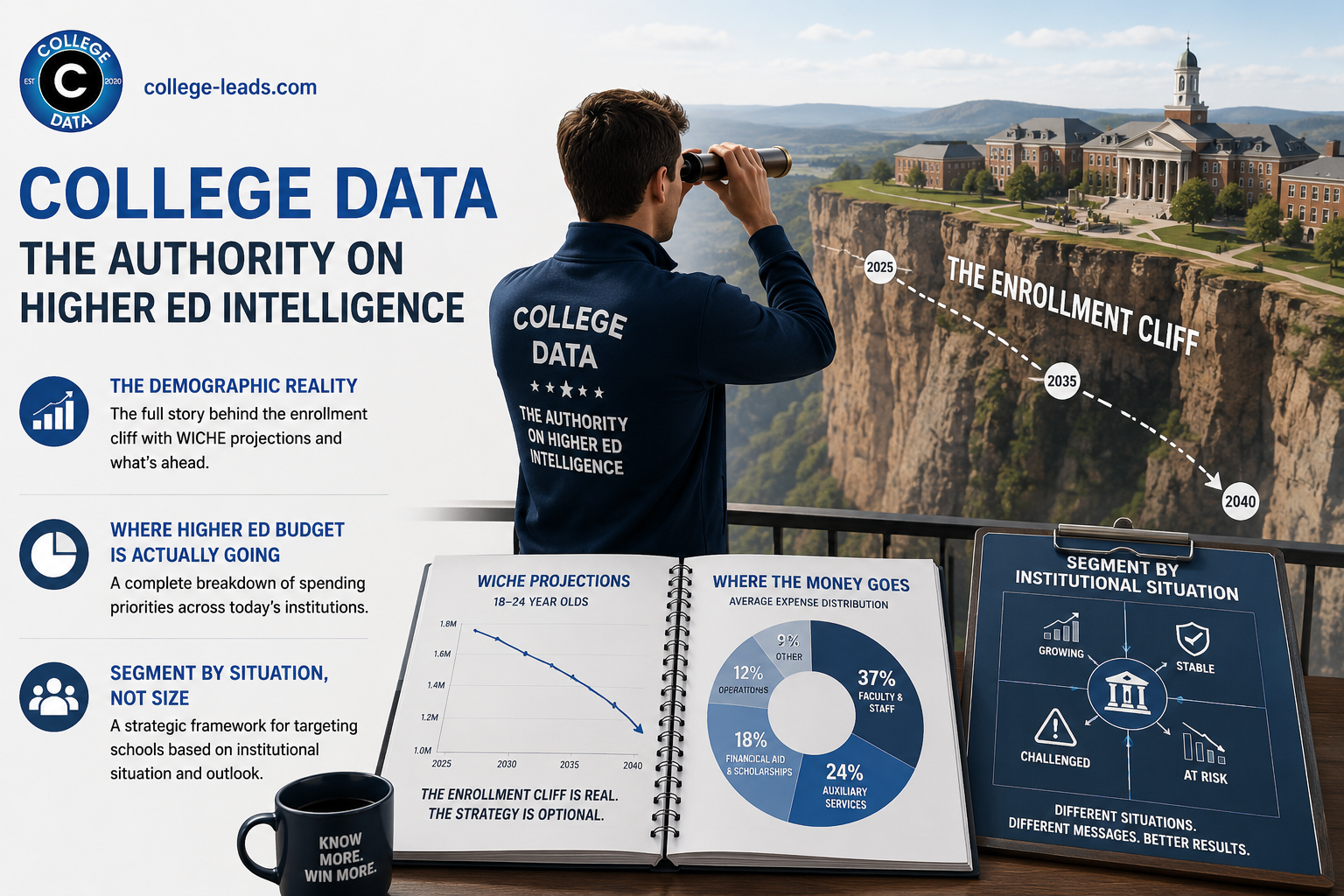
The birth rate decline that created the enrollment cliff was not subtle. Between 2007 and 2012, the U.S. birth rate dropped significantly as families responded to economic uncertainty following the financial crisis. That cohort, born between 2008 and 2013, is now entering the traditional college age window of 18 to 22.
The impact on four-year enrollment projections has been well-documented. WICHE, the Western Interstate Commission for Higher Education, projects that the number of high school graduates will peak in 2025 and then decline through the early 2030s, with the steepest drops in the Northeast and Midwest. These are precisely the regions with the highest concentrations of small private colleges and regional public universities, the institutions most vulnerable to enrollment decline.
What is less discussed in the popular coverage of the enrollment cliff is the unevenness of the impact. Not all institutions are suffering equally. Research universities with strong national brand recognition and diverse revenue streams are largely insulated. Online-focused institutions and programs are growing. For-profit institutions serving working adults, career changers, and non-traditional students are in many cases expanding. Community colleges in high-growth population areas are hiring and investing.
For higher education vendors, that unevenness matters enormously. The institutions that are hurting need different things than the institutions that are growing. Reaching the right decision-makers at the right type of institution with a relevant message requires both accurate contact data and the institutional context to segment intelligently.
The spending patterns of institutions under enrollment pressure are revealing. Rather than cutting across the board, most institutions are making deliberate redirections of budget toward capabilities they believe will help them compete.
Enrollment management technology is one of the clearest growth areas. Customer relationship management platforms built for higher education, predictive analytics tools for identifying and nurturing prospective students, and digital marketing infrastructure for reaching non-traditional audiences are all seeing increased investment even at institutions that are cutting other budgets.
Student success and retention platforms are another growth category. Institutions that cannot grow enrollment by attracting more new students are focusing on keeping the students they have. Early alert systems, advising technology, and financial aid modeling tools that help identify at-risk students before they drop out are in high demand.
Institutional research and data capabilities are also seeing investment. Colleges and universities that want to make evidence-based decisions about program offerings, pricing, and market positioning need better data infrastructure. The vendors and consultants who can help institutions understand their own enrollment data and competitive positioning are well-positioned.
Finally, alternative revenue development is a growing priority. Institutions are investing in workforce development partnerships, corporate education programs, certificate offerings, and continuing education as ways to diversify revenue beyond traditional enrollment tuition. Vendors who serve those segments, including workforce training platforms, credentialing technology, and corporate learning partners, are finding receptive audiences at institutions that would not have prioritized them five years ago.
The decision-making structure in higher education has shifted significantly over the past decade, and that shift has accelerated under enrollment pressure. Understanding who controls budgets at institutions in different situations is essential for any vendor trying to reach them effectively.
At the C-suite level, the president and provost still set institutional direction. But budget authority for technology, marketing, and operational services has increasingly migrated to VP-level roles. The VP of Enrollment Management, VP of Student Success, VP of Information Technology, and VP of Marketing and Communications are often the relevant buying decision-makers for the categories where vendors are competing most actively.
Below the VP level, directors and associate provosts in academic affairs, institutional research, and student services often carry significant influence over purchasing decisions in their domains. Reaching only the VP without influencing the staff level often results in a deal that stalls.
For smaller institutions, the decision-making structure is compressed. A dean or director may carry budget authority that at a larger institution would belong to a VP. And the president or provost may be directly involved in decisions that at a research university would never reach that level.
College Data maintains verified contacts across all of these roles, with records that reflect current titles, current institutions, and current email addresses. The database covers two- and four-year institutions across public, private non-profit, and for-profit sectors, with the segmentation depth to reach exactly the right role at exactly the right type of institution.
Higher education contact data has its own specific decay dynamics that differ from K-12, healthcare, and other verticals.
Administrative turnover in higher education has accelerated under enrollment pressure. VPs of Enrollment Management, in particular, have short tenures at many institutions as boards and presidents respond to enrollment shortfalls by replacing leadership. A contact that was accurate 18 months ago may no longer be in their role.
Institutional restructuring is also common. Colleges and universities under financial pressure frequently reorganize, consolidate departments, eliminate positions, and create new roles. A director of retention who reported to Academic Affairs two years ago may now report to a newly created VP of Student Success. Their email address may have changed. Their area of responsibility may be different.
And higher education has a specific data challenge that does not exist in most other verticals: the academic calendar creates a concentrated churn window. A large number of administrative transitions happen between May and August, as the academic year ends and new contracts begin. A database that was verified in March may have meaningful inaccuracy by October if it was not updated over the summer.
College Data addresses this by maintaining continuous verification processes year-round, with particular attention to the May through August transition window. Records are flagged for review when public sources suggest a leadership change has occurred, and updates are made before the stale record is delivered to a client.
The most effective approach to higher education outreach right now involves segmenting by institutional situation before segmenting by role or geography.
Institutions under acute enrollment pressure are the most motivated buyers for solutions that directly address their survival challenges. Enrollment management technology, student success platforms, and revenue diversification services are the highest-priority conversations at these institutions. Reaching the VP of Enrollment Management or the VP of Student Success with a relevant, specific message about their situation will get more traction than a generic product pitch.
Institutions in growth mode, including online-focused universities, for-profit career schools, and community colleges in population-growth markets, need different things. Scaling infrastructure, expanded program offerings, and marketing capabilities are the relevant conversations. The decision-makers are often different roles than at traditional four-year institutions.
Stable institutions, primarily well-endowed private colleges and flagship public universities, are the most competitive sales environments. They receive more vendor outreach, have longer sales cycles, and often have incumbent vendor relationships that are difficult to displace. Reaching them requires both accurate contact data and a differentiated value proposition.
The segmentation that College Data supports makes these distinctions possible. Institution type, sector, enrollment size, geographic region, and Carnegie classification are all available as filters, allowing vendors to build targeted outreach lists that reflect the strategic landscape of the higher education market rather than treating all colleges and universities as a single undifferentiated audience.
The enrollment cliff is not going to reverse. The demographic reality is set for at least another decade. That means the higher education market is going to continue evolving, and the vendors who build their outreach infrastructure around that evolution are the ones who will grow their higher education revenue while their competitors struggle.
The immediate priority is contact data accuracy. Campaigns built on stale higher education contact data will underperform regardless of how well the message is crafted. Verifying that your current database reflects current institutional realities, current roles, and current email addresses is the prerequisite for everything else.
The medium-term priority is segmentation strategy. Understanding which institutions are in which situation, and having the contact data to reach the right decision-makers at each type of institution, is what separates a scatter-shot outreach approach from a targeted one.
The long-term priority is relationship depth. Higher education is a relationship-driven sales environment. Vendors who invest in nurturing relationships with multiple contacts at the same institution, at multiple levels of the decision-making hierarchy, build the kind of embedded presence that survives individual personnel changes.
College Data is built to support all three priorities. The database covers the higher education contact landscape with the depth and accuracy that effective outreach requires. To explore the database and request a sample, visit college-leads.com.
Charles Isham is the founder and CEO of K12 Data, Inc. and a portfolio of B2B data platforms covering education, healthcare, and government. A U.S. veteran with more than 15 years in education data, he oversees a database of more than 5 million verified contacts across K-20 education, healthcare, and public-sector verticals. He writes on data-driven outreach, hiring trends, and B2B marketing strategy. Reach him at Charlie@k12-data.com.




 0
0
POST A COMMENT