

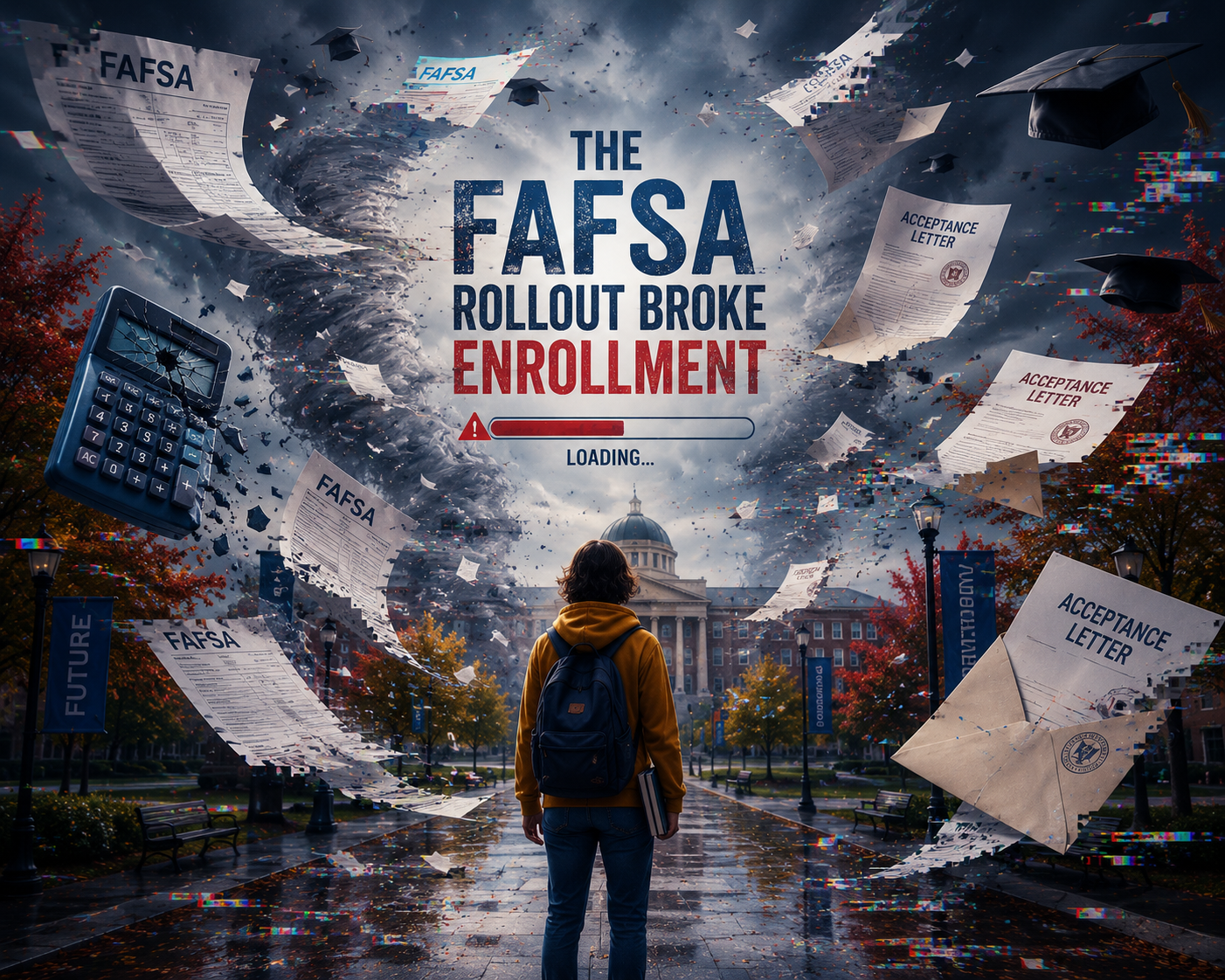
In theory, the FAFSA Simplification Act was supposed to make applying for college financial aid easier. The old form had 108 questions. The new one has 46. The math behind the Expected Family Contribution calculation was simplified. The whole thing was supposed to be faster, cleaner, and less confusing for the millions of students and families who fill it out every year.
In practice, the 2024-25 rollout was one of the most chaotic events in the history of college financial aid. The new FAFSA opened months later than planned. The calculations produced incorrect Student Aid Index numbers for millions of applicants. Institutional Student Information Records -- the data packages colleges need to make financial aid awards -- were delayed for months at many institutions. Some families received aid estimates that were wildly different from what they expected. Students who were counting on aid packages to make enrollment decisions were left waiting well into what should have been their decision period.
Colleges were caught in the middle. They could not make accurate financial aid offers without the data they were waiting for. Enrollment yield -- the share of admitted students who actually enroll -- fell at institutions that depend on financial aid offers to close the deal with prospective students. The recruiting cycle that colleges spend millions of dollars building and executing every year was disrupted at the exact moment it matters most.
The 2025-26 cycle has been better. The worst of the technical problems have been addressed. But better does not mean back to normal. The trust that families had in the financial aid process has been shaken. The institutional processes that depended on reliable FAFSA timelines have been rebuilt in ways that require new technology and new administrative approaches. And the purchasing wave that the crisis triggered is ongoing.
Here is the part that most vendors are missing. The people buying the technology to respond to the FAFSA crisis are Financial Aid Directors, Chief Enrollment Officers, and in some cases Provosts who have been forced to pay closer attention to enrollment yield than they ever did before. These are not the admissions technology buyers that most college mailing lists are optimized to reach. They are financial aid and enrollment recovery buyers who have become technology purchasers because a crisis forced them to be.
To understand why the FAFSA crisis created a technology purchasing emergency, you need to understand how the financial aid calendar works and what happens when it breaks down.
Every year, students apply for federal financial aid through the FAFSA. The government processes those applications, calculates a Student Aid Index number that represents how much a family is expected to contribute toward college costs, and sends that data to the colleges the student listed. The college then uses that data to build a financial aid package, which includes federal grants and loans, institutional grants, and sometimes work-study.
The timing of this process matters enormously. Colleges need to send financial aid offers in time for students to compare them and make enrollment decisions by May 1, which is the traditional National Candidates Reply Date. If the FAFSA data is delayed, the aid offers are delayed. If the aid offers are delayed, students either make uninformed decisions or delay their decisions past the point where colleges can plan their incoming class size accurately.
In the 2024-25 cycle, that is exactly what happened. Institutional data was delayed into February and March at many schools. Colleges that normally send financial aid packages in January and February were scrambling to send them in March and April. Some students did not receive complete packages until May, which is when they were supposed to be making their final decisions. The result was predictable: lower yield rates, more students opting for community college or gap years while they sorted out their finances, and a scramble by colleges to recover enrollment numbers they had already budgeted against.
The enrollment yield crisis was especially severe at the types of institutions that most depend on financial aid to close enrollment decisions: mid-tier private colleges, regional comprehensive universities, and institutions with significant first-generation student populations. These are the same institutions documented in College Data's research on the international student collapse and the domestic enrollment arms race as being under the most acute financial pressure from multiple directions simultaneously. For these schools, the FAFSA crisis was not an inconvenience -- it was a financial emergency.
The immediate response was a wave of emergency technology purchasing that most college mailing lists were not configured to anticipate or reach.
Financial aid verification platforms. When the FAFSA data that came in was incorrect -- and in many cases it was, producing SAI calculations that did not match what families had reported on their tax returns -- colleges needed tools to identify the errors, flag the affected applications, and reprocess them accurately. Verification platform vendors saw demand surge from colleges that had never needed those tools at scale before.
Student communication platforms. The colleges that managed the FAFSA crisis best were the ones that communicated proactively and frequently with admitted students and their families about what was happening, what they were doing about it, and what students should do in the meantime. The colleges that communicated poorly lost students to schools that communicated well. The purchasing consequence was a wave of investment in student communication platforms, personalization tools, and the enrollment counselor staffing and technology that supports high-touch outreach during a disrupted yield cycle.
Enrollment analytics and scenario modeling. The FAFSA crisis made it impossible to rely on historical enrollment models. Colleges that had always hit their enrollment targets within a predictable range suddenly had no reliable way to forecast how many students would actually show up in September. Enrollment analytics platforms that model yield under different financial aid and communication scenarios became a purchasing priority at institutions whose enrollment planning processes had been built on assumptions the FAFSA crisis made obsolete.
Financial aid optimization and net revenue modeling. The crisis forced many institutions to revisit their financial aid strategy from scratch. If the federal aid process cannot be relied on to work on schedule, what is the right institutional aid package to offer and when? How much should colleges front-load merit aid before federal aid data arrives? What is the right balance between enrollment yield and net tuition revenue when the FAFSA timeline is uncertain? Financial aid optimization platforms that model these tradeoffs became a purchasing priority at institutions whose CFOs and Financial Aid Directors were having conversations they had never needed to have before. The financial modeling urgency connects to what Civic Data's research on municipal CFOs and revenue cliff scenario modeling has documented in local government -- in both cases, an unexpected revenue disruption has elevated financial analytics technology from an optional enhancement to an operational necessity.
The Financial Aid Director went from being a compliance and service administrator to being a crisis manager and technology buyer in the span of one enrollment cycle. The people in these roles have spent the last two years evaluating, purchasing, and implementing technology that their predecessors never had to think about. They are buying verification platforms, communication tools, and analytics systems. They have budget authority they did not expect to exercise. And most college mailing lists treat them as secondary contacts behind admissions and academic technology leadership.
The Chief Enrollment Officer or VP of Enrollment Management became the most scrutinized administrator on campus when yield rates fell. These contacts were already purchasing enrollment marketing technology, CRM systems, and prospect analytics platforms. The FAFSA crisis added financial aid technology, student communication platforms, and yield recovery tools to their purchasing portfolio. At institutions where enrollment yield fell by 5 or more percentage points in the 2024-25 cycle, the CEO is making technology purchasing decisions with a direct mandate from the board and the president. College mailing lists that include enrollment management leadership as a primary purchasing contact are capturing this tier. Those that do not are missing it.
At some institutions, the FAFSA crisis was severe enough to pull Provosts and Chief Academic Officers into enrollment technology discussions they would not normally have. When enrollment shortfalls threaten program viability, academic affairs leadership becomes a stakeholder in the technology decisions that might prevent or recover from those shortfalls. University email lists that can segment institutions by enrollment stress and identify Provosts at those institutions as active participants in enrollment technology evaluation are reaching a purchasing conversation that standard higher education contact databases miss entirely.
Every college CFO became more interested in enrollment technology the year yield rates fell and tuition revenue projections had to be revised mid-year. The CFO is not selecting the specific technology, but they are authorizing the budget for enrollment recovery investment and demanding to see the ROI modeling that justifies it. College mailing lists that map the CFO as a co-approver alongside the Chief Enrollment Officer for major enrollment technology investments are providing contact coverage that matches how these decisions actually get made.
The immediate crisis purchases are done at most institutions. But the longer-term purchasing wave that the FAFSA disruption triggered is still active.
Institutions have realized that they cannot build enrollment models on the assumption that the FAFSA process will work smoothly. They are investing in enrollment resilience infrastructure -- the technology, data, and processes that allow them to manage yield effectively even when the federal financial aid system is not cooperating. That investment includes new CRM capabilities for personalized student communication, scenario modeling tools for financial aid strategy under uncertainty, and the data analytics infrastructure that gives enrollment teams early warning when yield trajectories are going off course.
The community college and adult learner markets have seen a specific kind of demand growth from the FAFSA crisis. Students and families who found the financial aid process confusing and unreliable have shown increased interest in institutions that can make the economics of attendance simple and predictable without depending on federal financial aid. This connects directly to College Data's research on the adult learner reskilling surge and the institutions growing fastest by serving non-traditional students. The colleges that offer clear, consistent financial commitments to adult learners who are paying with employer tuition benefits or personal savings rather than federal aid have a genuine competitive advantage right now.
The K-12 connection to the FAFSA crisis is often overlooked but it is real. Students who encounter a chaotic financial aid process during their college search are more likely to pursue dual enrollment, community college, and workforce credential pathways that they explored during high school. K12 Data's research on the dual enrollment explosion documents how the growth of dual enrollment is partly driven by students and families who want to accumulate college credit without navigating the full financial aid application process. Vendors with college mailing lists alongside school mailing lists from K12 Data can reach both the postsecondary institutions managing the FAFSA crisis response and the K-12 districts feeding students toward alternative credential pathways.
The government regulatory dimension of the FAFSA crisis is significant. The Department of Education's management of the FAFSA rollout has led to calls for greater state-level oversight of federal financial aid processing and increased state investment in financial aid advising and technology. Civic Data's research on how state agencies are absorbing federal program management responsibilities documents the broader pattern of federal program authority devolving to states, of which the FAFSA crisis is one example. State higher education agency officials who are building state-level financial aid oversight infrastructure are purchasing contacts that civic mailing lists from Civic Data and college mailing lists from College Data together can reach.
• Add Financial Aid Directors to your primary contact tier in college mailing lists. They are not secondary contacts behind admissions and academic technology leadership anymore. They have purchasing authority and purchasing urgency that most higher education contact databases have not recognized.
• Segment institutions by enrollment yield change from 2024-25 to 2025-26. Colleges that experienced yield declines of 5 or more percentage points are still in active purchasing mode for enrollment recovery technology. This data is available through IPEDS and institutional press releases about enrollment outcomes.
• Include CFOs in enrollment technology outreach. Not as the primary contact, but as a named co-approver. College mailing lists that map the CFO relationship alongside the Chief Enrollment Officer contact are providing the full buying committee coverage that major technology purchases require.
• Time outreach around the FAFSA processing calendar. The next FAFSA processing disruption -- or the fear of one -- drives enrollment technology purchasing urgency in September through December. University email lists used for enrollment technology outreach should be activated on this calendar, not on the standard spring planning timeline.
• Connect financial aid technology outreach to enrollment analytics. Vendors who can speak to both the financial aid verification problem and the enrollment yield analytics challenge are entering a richer conversation than vendors who address only one side of what is now a unified operational challenge.
The FAFSA Simplification Act was supposed to make college more accessible. The rollout made one enrollment cycle significantly more chaotic. The institutions that suffered most have spent the time since building technology infrastructure to make sure they are not caught flat-footed again.
That infrastructure investment is ongoing. The vendors whose college mailing lists and university email lists reach Financial Aid Directors, Chief Enrollment Officers, and CFOs as the primary buying committee for enrollment recovery technology are competing for contracts that their competitors do not even know exist. The vendors still routing higher education outreach through admissions and academic technology contacts are reaching people who may eventually forward the message to the right person, but probably will not.
K12 Data -- Build a List | Pricing | Blog College Data -- Build a List | Pricing | Blog Physician Data -- Build a List | Blog Civic Data -- Build a List | Blog




 0
0
POST A COMMENT