

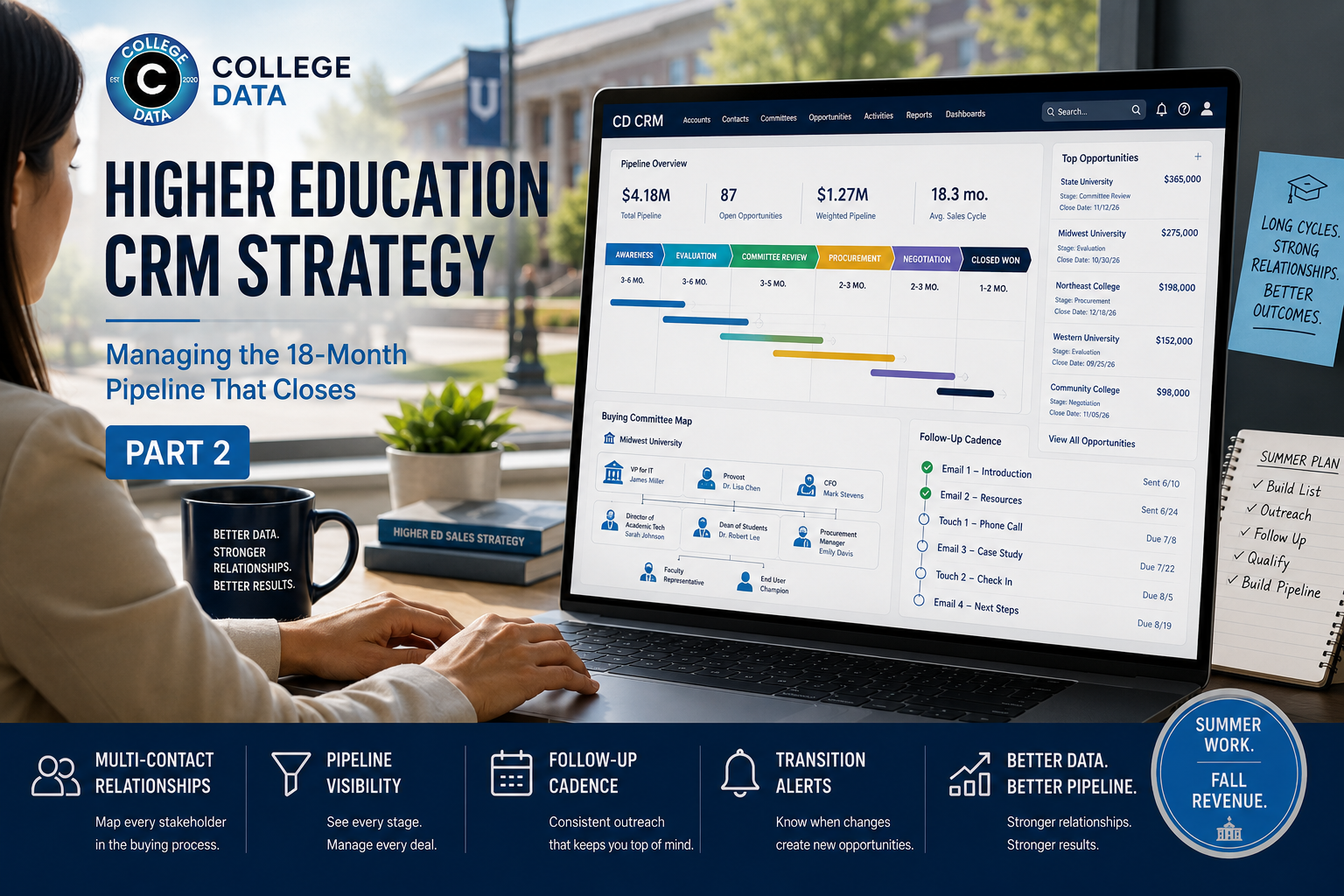
Part 1 made the case that summer is the best outreach window in the higher education vendor calendar. Administrators have time to think. Budgets are freshly approved. Your college mailing lists face less inbox competition than at any other point in the year. Read Part 1 if you have not.
Part 2 is about the harder question: what do you do with a sales cycle that can run 9 to 18 months from first contact to signed contract? How do you manage a pipeline that long without giving up on deals that are still active, or wasting time on deals that died six months ago and nobody updated the CRM to reflect?
These are the questions that separate teams that build compounding pipeline in higher education from teams that work hard, get decent open rates, and wonder why their close rate is low.
The 9-to-18-month purchasing timeline in higher education is not going to compress because you send more emails or run a better demo. It is the product of shared governance processes, faculty and staff consultation, multi-department evaluation committees, financial review, legal review, board presentation, and procurement compliance requirements. Understanding this is the first step toward managing it productively rather than fighting it.
The enrollment crisis has shortened the timeline for a specific subset of purchases. Institutions managing FAFSA yield fallout, international enrollment decline, or micro-credential build-out on emergency timelines are making technology decisions faster than the standard process allows. These are not the institutions to approach with a long nurture sequence. They are the institutions to approach with a clear message and a short path to procurement -- knowing whether your product is on a cooperative purchasing contract or state contract vehicle. The College Data blog library documents these institutional urgency types in detail so you can identify which sales motion applies before your first outreach.
A significant higher education technology purchase involves multiple stakeholders. The Chief Enrollment Officer evaluates enrollment impact. The CFO evaluates financial fit. The Provost evaluates academic alignment. The IT Director evaluates integration and security. The Financial Aid Director evaluates compliance implications. Your CRM needs to track your relationship with each of these contacts separately at the same institution, with separate relationship stages and separate next steps. A deal where you have a strong relationship with the Chief Enrollment Officer and no relationship with the CFO is a deal at risk when the CFO gets the approval request.
Higher education decisions happen on academic and fiscal calendars. Budget approvals happen in April and May at most institutions. Board presentations happen on board meeting schedules. New program launches happen on semester timelines. Add a field for "next decision event" -- the specific date or event that will advance the evaluation. When you know the decision events, you know when to be most active, when to give space, and when to bring in a reference from a peer institution that has been through the same process.
The note that says "Provost mentioned at a conference that they are unhappy with their current LMS vendor and will evaluate alternatives in eighteen months" is worth money in sixteen months. The note that says "Financial Aid Director said their FAFSA process was a disaster and they are building a case for new enrollment analytics" is worth knowing when enrollment analytics appears in a board agenda. Institutional knowledge that lives in someone's head walks out the door when they leave. The CRM is the institutional memory of the account relationship.
Higher education administrators do not respond to persistent badgering. They respond to persistent usefulness -- the vendor who keeps showing up with something worth reading rather than a reminder that they exist.
• First follow-up: two weeks after initial contact. A new piece of relevant information about their specific institutional type, a recent enrollment or credentialing development, a case study from a peer institution. Not "just checking in." Something worth reading.
• Second follow-up: four weeks after initial contact. A resource or a genuine question. A report relevant to their specific challenge. A question about how they are approaching something you know they are dealing with. Curiosity about the institution gets responses that standard follow-up sequences do not.
• Third follow-up: six to eight weeks after initial contact. Direct and respectful. "I have reached out a few times and do not want to keep doing so if the timing is not right. If this is not a priority now, just let me know when to check back." This consistently produces a response because it treats the contact as a professional with limited time rather than a name on a university email list.
For your top twenty to thirty institutions -- where a relationship would materially change your year -- extend the sequence to four or five contacts over three to four months, timed around academic calendar decision moments.
Enrollment declines are reported in IPEDS and institutional press releases. Micro-credential program launches are announced in higher education trade press. FAFSA yield crisis impacts show up in enrollment outcome reporting. A college mailing list enriched with these urgency signals -- identifying which institutions are in active response mode for which challenges -- enables genuinely targeted outreach rather than segmentation by institutional type alone.
University email lists from before 2022 are missing VP of Enrollment Strategy, Director of Digital Credentials, Director of Domestic Market Development, and ISSO Director as distinct contact categories. These are not niche roles at unusual institutions. They are standard titles at the institutions under the most acute enrollment and credentialing pressure -- precisely the institutions in the most active vendor evaluation mode right now.
Cross-reference across sectors. Adult learner and workforce development programs driving community college growth connect to K-12 CTE programs tracked in K12 Data's school mailing lists and to state workforce officials tracked in Civic Data's government mailing lists. Healthcare workforce education programs at community colleges connect to clinical workforce contacts in Physician Data's physician mailing lists. Vendors with cross-sector data serve the full institutional partnership rather than one side of it.
Open rate is not the metric. In a world where iOS privacy changes and Gmail preview panels generate opens without a human reading the email, open rate tells you almost nothing useful. The metrics that correspond to actual pipeline movement are: reply rate, meeting booked rate, and pipeline stage advancement rate. If your reply rate on a well-targeted campaign to a segmented university mailing list is below 0.5 percent, something is wrong with the message or the list. Knowing which one requires measuring the right thing.
Part 1 covered summer outreach strategy, email fundamentals, and college mailing list hygiene. This is Part 2. The same framework runs for K-12 at K12 Data, for healthcare at Physician Data, and for government at Civic Data.
K12 Data -- Build a List | Pricing | Blog College Data -- Build a List | Pricing | Blog Physician Data -- Build a List | Blog Civic Data -- Build a List | Blog




 0
0
POST A COMMENT