

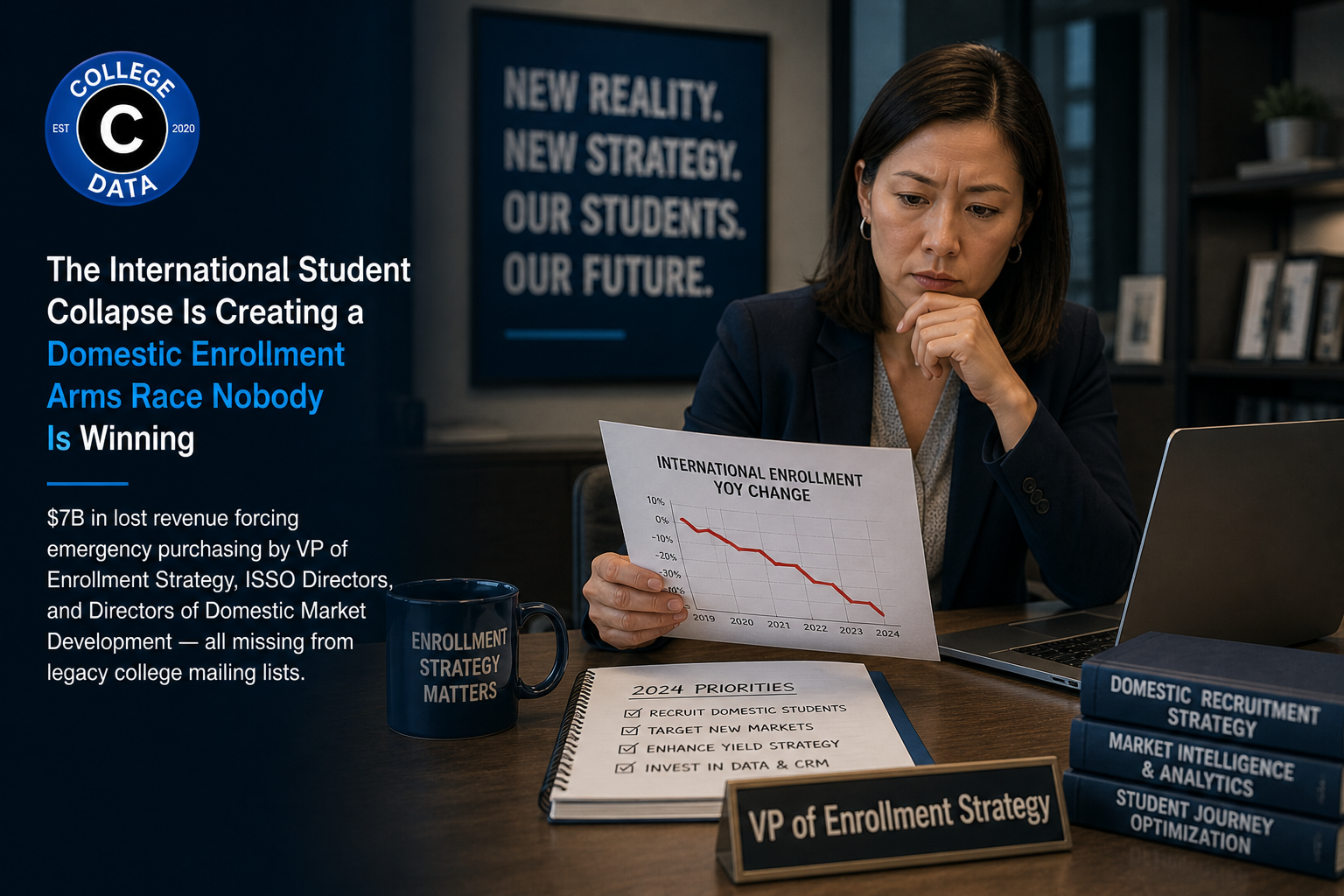
NAFSA: Association of International Educators projects up to 150,000 fewer international students enrolled in U.S. institutions in the 2025-26 academic year — nearly $7 billion in lost economic impact. This is not a temporary dip. It is the convergence of visa processing uncertainty, SEVIS fee escalations, shifting geopolitical relationships with the largest student-origin countries, and a growing international perception that studying in the United States has become a more complicated and less welcoming proposition than it was five years ago.
The institutions most exposed are not the elite research universities whose endowment strength provides a multi-year buffer. They are mid-tier private colleges, regional comprehensive universities, and specialized institutions where international students constitute 15, 20, or 30 percent of enrollment — and where the financial modeling that determines institutional viability through 2030 was built on enrollment projections the current market has invalidated.
For technology vendors, enrollment marketing firms, financial aid platform providers, and student success technology companies, the institutional response to the international student collapse is generating emergency purchasing conversations unlike anything the higher education vendor market has seen in recent years. The administrators leading those conversations are not the traditional admissions and academic leadership contacts that most college mailing lists and university email lists were built to prioritize. They are a new purchasing tier — Vice Presidents of Enrollment Strategy, Directors of Domestic Market Development, ISSO Directors managing compliance and enrollment recovery simultaneously — whose roles have been elevated, expanded, or created specifically in response to the crisis.
Fitch, Moody's, and S&P have all issued negative outlooks for higher education in 2025 and 2026, citing international enrollment volatility as a primary risk factor for mid-tier and regional institutions. The financial modeling is straightforward and alarming: an institution with 2,000 international students paying a $20,000 annual tuition premium over domestic students is generating $40 million in annual revenue above what its domestic enrollment alone would produce. A 25 percent reduction — well within the NAFSA projection range for some institution types — represents a $10 million annual shortfall that no domestic enrollment growth strategy can replace quickly enough to prevent operational disruption.
The immediate responses are visible across the market: emergency recruitment partnerships with domestic pathway providers, accelerated direct admission programs targeting first-generation and rural students who have been underrepresented in traditional pipelines, aggressive online and hybrid program expansion designed to attract working adult domestic learners, and emergency review of financial aid packaging strategies to make domestic tuition revenue more competitive.
Each of these response strategies generates distinct purchasing conversations for enrollment marketing technology, CRM platforms, financial aid optimization tools, and online program delivery infrastructure. The working adult domestic learner pivot connects directly to the reskilling demand documented in the K12 Data dual enrollment research — the same districts investing in dual enrollment and CTE today are producing the workforce-oriented credential seekers that continuing education programs are competing to enroll in three to five years. Organizations with college mailing lists alongside school mailing lists from K12 Data are positioned to reach the full enrollment pipeline from secondary through postsecondary simultaneously.
At institutions experiencing the most acute international enrollment declines, the VP of Enrollment Strategy or Chief Enrollment Officer has been elevated to a cabinet-level role with emergency purchasing authority across enrollment marketing, CRM, financial aid modeling, and student success technology. This is not the traditional Dean of Admissions role. It is a strategic executive position created or elevated in response to the enrollment crisis — carrying purchasing authority most college mailing lists have never associated with enrollment leadership because enrollment leadership previously operated within a narrower budget mandate. University email lists that do not include this contact as a primary executive purchasing tier are missing the highest-authority decision-maker for the fastest-moving purchasing category in higher education.
The Director of Domestic Market Development is appearing at institutions whose geographic and demographic recruitment strategies are being fundamentally rebuilt in response to the international enrollment decline. These administrators develop and execute the domestic recruitment strategy that replaces lost international revenue — including direct admission programs, new geographic market development, adult learner outreach, and employer partnership programs. They are purchasing enrollment marketing technology, audience intelligence platforms, and CRM tools configured for domestic market development. They are almost entirely absent from standard college administrator email lists built before the international enrollment collapse created this purchasing tier.
The International Student and Scholar Office Director is experiencing one of the most dramatic role expansions of any administrative position in higher education in 2026. Originally a compliance and student services function, the ISSO Director is now simultaneously managing compliance complexity under an increasingly restrictive regulatory environment and functioning as a strategic advisor to enrollment leadership on international enrollment recovery. The technology needs this dual mandate creates — compliance management systems, international student tracking platforms, visa documentation workflow tools, and enrollment recovery scenario analytics — are generating purchasing conversations that most university email lists have not mapped as a distinct ISSO contact tier with technology evaluation authority.
The financial aid office at institutions experiencing international enrollment declines has become a strategic revenue management function. Financial Aid Directors are now evaluating net revenue optimization platforms, financial aid modeling tools, and enrollment yield analytics systems — purchasing categories most college mailing lists associate with institutional research rather than financial aid leadership. The Financial Aid Director whose mandate has expanded to include domestic enrollment revenue optimization is a purchasing contact requiring college mailing lists built to reflect the 2026 institutional reality rather than the pre-crisis enrollment management model.
CRM and enrollment marketing technology vendors. The domestic enrollment pivot requires CRM infrastructure configured for fundamentally different audience behaviors than international student recruitment — different communication channels, different financial aid transparency requirements, different yield intervention timelines. Institutions rebuilding their domestic enrollment CRM are making technology replacement decisions on compressed timelines driven by enrollment urgency. The VP of Enrollment Strategy and Director of Domestic Market Development are the primary purchasing contacts, not the traditional admissions technology director.
Financial aid modeling and net revenue optimization platforms. The financial aid strategy required to attract domestic students to institutions that previously relied on international tuition premiums is fundamentally different from what those institutions operated before the decline. Net revenue optimization platforms are in emergency evaluation at institutions whose financial planning assumptions require urgent revision. Financial Aid Directors with expanded revenue management mandates are the primary purchasing contacts.
Online program development and delivery vendors. The fastest available domestic enrollment growth vehicle for institutions experiencing international decline is online and hybrid program expansion — capturing adult learner populations who do not require campus infrastructure. This is the same adult learner market documented in the K12 Data dual enrollment research at the pipeline origin point, and the same workforce reskilling demand documented in Physician Data's research on mid-career healthcare professionals entering clinical instruction roles at community colleges. College mailing lists, school mailing lists from K12 Data, and physician mailing lists from Physician Data used together reach the full cross-sector picture of the adult learner market from pipeline to program to employer.
International student compliance technology vendors. Managing SEVIS requirements, visa status monitoring, and compliance documentation for a declining but still-significant international population is generating demand for compliance automation that most ISSO offices previously managed manually. Civic Data's research on how government regulatory compliance mandates are creating parallel technology purchasing urgency in public sector agencies documents the same compliance-driven purchasing dynamic in government — creating a shared technology conversation for compliance platform vendors whose government mailing lists and college mailing lists reach both institutional types simultaneously.
• International enrollment exposure as the primary segmentation signal. College mailing lists that identify institutions where international students constitute more than 15 percent of enrollment are targeting the institutions under the most acute revenue pressure and in the most urgent domestic enrollment pivot — the most active purchasing environment for enrollment marketing, financial aid optimization, and online program development technologies.
• VP of Enrollment Strategy and Director of Domestic Market Development as primary contact tiers. University email lists targeting the enrollment emergency market must include these roles as distinct, high-priority contact categories whose purchasing authority is driven by enrollment recovery urgency rather than standard technology refresh cycles.
• ISSO Director as a technology purchasing contact. College administrator email lists that include ISSO Directors only as compliance contacts are missing the compliance management and international student tracking technology evaluation that ISSO offices are conducting under expanded mandates.
• Credit rating trend as a purchasing urgency signal. Institutions that have received negative credit outlook ratings from Fitch, Moody's, or S&P are operating under the most acute financial pressure and making purchasing decisions on compressed timelines driven by financial recovery urgency. Higher education marketing data including credit rating context is a significant targeting precision enhancement.
• Institutional type and financial model segmentation. Mid-tier private colleges and regional comprehensives with high international enrollment percentages are the primary targets. Higher education mailing lists that segment by institutional type and international enrollment concentration are reaching the most urgent buyers first.
Direct admission will become the dominant domestic recruitment strategy for enrollment-stressed institutions. The combination of enrollment cliff demographics, international enrollment volatility, and the demonstrated effectiveness of direct admission programs in reaching underrepresented domestic students is driving broad adoption at precisely the institutional types under the most acute revenue pressure. The vendors whose college mailing lists identify institutions in active direct admission program development and reach the Directors of Domestic Market Development leading those initiatives are entering the most consequential purchasing conversations in higher education marketing technology.
The international enrollment recovery will be slow and geographically uneven — creating a prolonged purchasing urgency for the domestic enrollment strategy tools and technologies that institutions are adopting to replace lost revenue. This prolonged urgency means the emergency purchasing conversations that college mailing lists are positioned to reach today will still be active in 2027 and 2028. Organizations that build higher education contact data infrastructure now — connecting college mailing lists to school mailing lists from K12 Data for pipeline intelligence, government mailing lists from Civic Data for workforce development grant context, and physician mailing lists from Physician Data for healthcare program faculty pipeline data — are building a multi-sector contact intelligence advantage that single-sector higher education mailing lists cannot match.
The international student collapse of 2025-2026 is generating emergency purchasing conversations across CRM, financial aid optimization, online program development, and compliance management technology that are driven by contacts and purchasing timelines that most college mailing lists and university email lists were not built to reach. The vendors whose higher education contact data reflects this 2026 reality — VP of Enrollment Strategy, Director of Domestic Market Development, and ISSO Director as distinct primary purchasing contacts — are entering conversations at institutions where the urgency to buy is as high as it has ever been in the higher education vendor market.
K12 Data — Build a List | Pricing | Blog College Data — Build a List | Pricing | Blog Physician Data — Build a List | Blog Civic Data — Build a List | Blog




 0
0
POST A COMMENT