

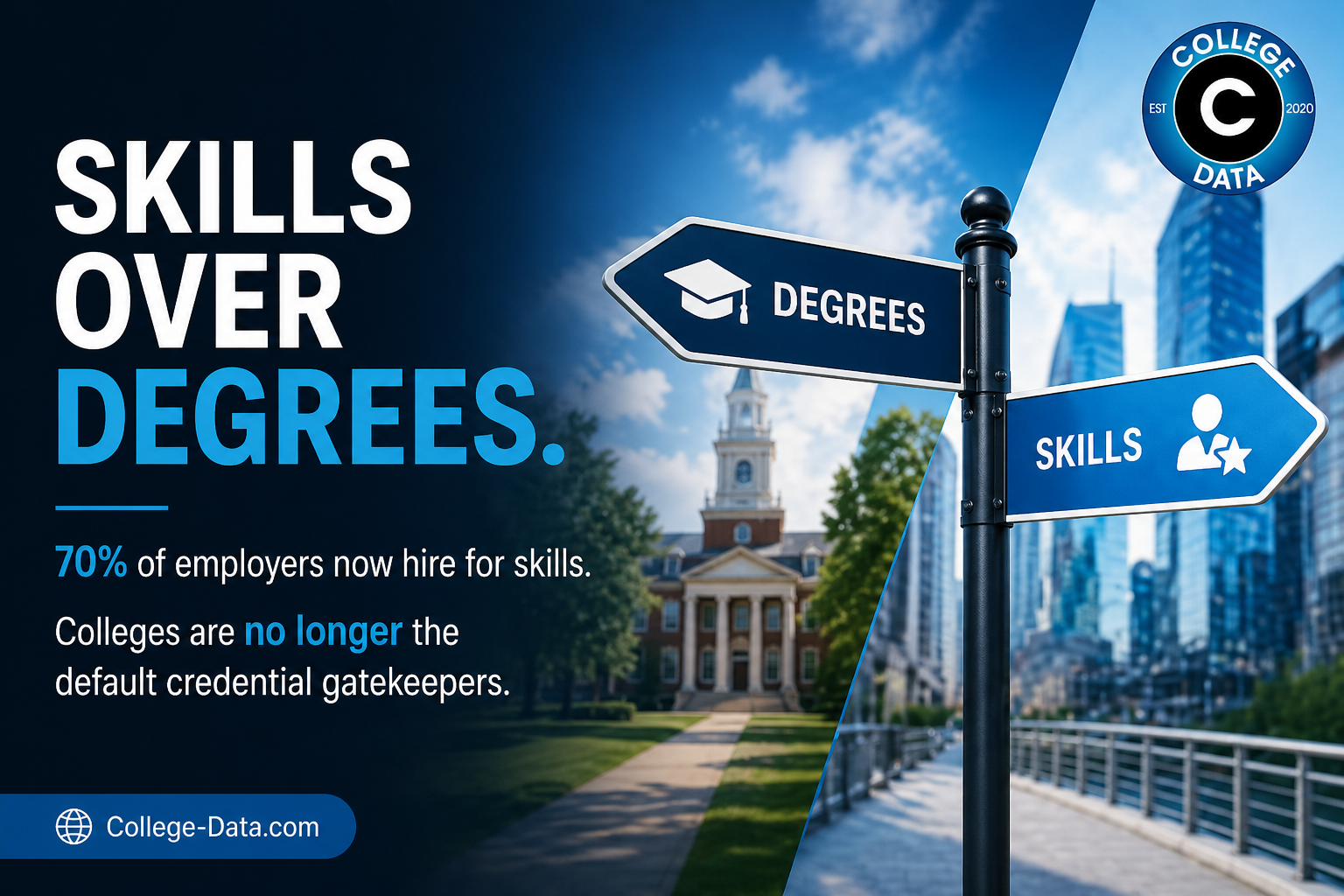
The numbers from NACE's Job Outlook 2026 survey are among the most consequential data points in higher education's recent history. Seventy percent of employers now report using skills-based hiring for entry-level positions, up from 65 percent the previous year. GPA screening — for decades a primary employer filter — has dropped from 73 percent of employers using it in 2019 to just 42 percent today. More than 80 percent of employers now include specific skills requirements in their job descriptions rather than credential requirements. McKinsey research finds that hiring for skills is five times more predictive of job performance than hiring based on education alone. Companies like IBM, Google, Boston Consulting Group, and Accenture have publicly removed degree requirements from significant portions of their job postings.
For higher education institutions, this is a direct challenge to the core value proposition that colleges have sold to prospective students and their families for generations: that the four-year degree is the most reliable pathway to career readiness and economic mobility. The rise of alternative credentials — micro-credentials, stackable certificates, industry-recognized badges, bootcamp certificates — is enabling learners and employers to bypass the traditional four-year degree pathway in ways that were not practically viable five years ago. Google's certificate programs in IT support and data analytics are now accepted as entry-level qualifications at major employers. The 36.8 million Americans with some college and no credential represent both a challenge and an opportunity for institutions willing to create the flexible, modular pathways that skills-based hiring makes relevant.
For technology vendors, curriculum development organizations, workforce alignment consulting firms, micro-credential platform providers, and career outcome analytics companies selling into the higher education market, the skills-based hiring revolution is generating new purchasing conversations at institutions responding to this disruption. But the decision-makers driving those conversations are not the same contacts that drove higher education purchasing before the degree-to-job pipeline disruption became undeniable. Most college mailing lists and higher education email lists are still routing outreach to traditional academic leadership rather than to the workforce alignment, employer relations, and career outcome contacts who are co-sponsoring the purchasing decisions that the skills-based hiring era requires.
The enrollment implications are already visible. Short-form program enrollment has surged, particularly among adult learners and professionals seeking reskilling. Community colleges — which saw the strongest enrollment growth of any institutional type in fall 2025 at 3 percent — are benefiting from the shift toward shorter, more directly employment-linked credentials. Four-year institutions watching the fastest-growing segment of the higher education market move away from traditional degree programs are making significant investments in employer relations management, career outcome analytics, and micro-credential delivery infrastructure that constitute entirely new vendor relationship categories.
Institutions responding to the skills-based hiring disruption are investing in employer relations management platforms that systematize industry partnership development. They are purchasing career outcome analytics tools that allow them to demonstrate specific skills-to-employment pathways to prospective students. They are building or buying micro-credential and certificate program delivery infrastructure. And they are evaluating workforce alignment consulting services that can help traditional academic programs redesign curriculum around skills outcomes that employers can actually verify.
These are new purchasing categories at institutions that did not have dedicated workforce alignment functions three years ago — and the contacts driving these purchases are new to the higher education vendor conversation. Chief Workforce Officers — a title that barely existed outside of regional universities focused on workforce development five years ago — are appearing at institutions that have elevated workforce alignment to a cabinet-level strategic function. VPs of Career Services who previously managed career fairs and resume reviews are now co-sponsors of employer relations management platform purchases. Deans of Continuing Education who ran professional certificate programs as revenue supplements are now running the fastest-growing segment of institutional enrollment.
The nextSource white paper published in February 2026 frames this directly: skills-based hiring and alternative credentials are no longer fringe trends — they are reshaping the Future of Work and redefining how talent is developed, evaluated, and deployed. As employers prioritize demonstrable skills over traditional degree signals, higher education faces a pivotal moment. Institutions must adapt with intention or risk declining relevance.
• Employer relations and workforce alignment platform vendors. Employer relations management platform vendors selling tools that help institutions systematize industry partnerships, employer advisory boards, and job placement data collection are in one of the most actively evaluating purchasing categories in higher education in 2026. The buyers — Directors of Employer Relations, VPs of Career Services, and the emerging Chief Workforce Officer role — are largely absent from most college mailing lists and university email lists, which were built when career services was an administrative support function rather than a strategic purchasing authority.
• Career outcome analytics and skills assessment vendors. Career outcome analytics vendors providing the skills-to-employment pathway data that prospective students and accreditors are increasingly demanding are addressing one of the most acute information gaps in higher education. The buyers — Institutional Research Directors, Chief Data Officers, and career outcome analytics leadership — represent a cross-functional committee that straddles traditional institutional research and workforce strategy in ways that most college administrator email lists do not map.
• Micro-credential and certificate delivery platform vendors. Micro-credential and certificate program delivery platforms selling the infrastructure for developing, delivering, and badging short-form programs are finding a buyer population that did not exist at most institutions before the skills-based hiring disruption made short-form credentials strategically necessary. The buyers — Deans of Continuing Education, Directors of Professional Development, and digital credentials leadership — require college mailing lists that include non-traditional academic leadership as distinct high-priority contacts.
• Curriculum redesign and workforce alignment consultants. Curriculum redesign and workforce alignment consulting firms helping traditional academic programs map course outcomes to skills frameworks that employers use are addressing a capability gap most academic departments cannot fill from within. The buyers — Academic Deans, Provosts, and Directors of Curriculum Alignment — represent a new purchasing audience for consulting categories that previously sold primarily to corporate training markets rather than traditional higher education.
• Chief Workforce Officer / VP of Workforce Strategy. The new cabinet-level authority for workforce alignment at institutions that have recognized skills-based hiring as a strategic threat to their enrollment value proposition. CWOs hold purchasing authority over employer relations management platforms, career outcome analytics, and workforce partnership infrastructure in ways that sit outside traditional academic governance structures. Most college mailing lists do not include this title as a distinct contact category because it has emerged primarily in the last 18-24 months.
• VP of Career Services / Director of Career Outcomes. Elevated in organizational authority from career services support to strategic workforce alignment leadership at institutions that have made employer relations a board-level priority. VPs of Career Services in 2026 are co-sponsors of technology investments that would previously have been procurement afterthoughts. A university contact database or college email list that treats career services as a secondary contact tier is misreading the current authority structure at skills-focused institutions.
• Dean of Continuing Education / Professional Development. Deans of Continuing Education and Professional Development are the operational buyers for micro-credential program delivery platforms, workforce development curriculum, and the short-form program infrastructure that the skills-based hiring disruption has made strategically essential. These contacts hold purchasing authority for the highest-growth segment of the higher education market — non-degree programs for adult and professional learners — and they are consistently underweighted in college mailing lists built around traditional degree-program academic leadership.
• Director of Institutional Research / Chief Data Officer. Institutional Research Directors are the analytical co-sponsors of career outcome analytics purchases, providing the data infrastructure that allows institutions to generate the skills-to-employment pathway transparency that prospective students and accreditors are demanding. Their role in technology evaluation has expanded significantly as the metrics that matter most for institutional accountability have shifted from traditional academic outcomes to workforce placement and skills development indicators.
• Traditional academic leadership at the strategic approval level. Traditional Admissions Directors and academic Provosts remain essential contacts at the program evaluation and strategic approval levels. But the skills-based hiring response is generating purchasing authority at career outcome, workforce alignment, and continuing education leadership levels that most traditional higher education contact databases do not include as a distinct purchasing tier.
• Workforce alignment program status as the primary segmentation signal. Institutions with active micro-credential or stackable certificate programs, industry-embedded curriculum projects, or publicly stated employer partnership strategies represent the most advanced adopters of skills-based hiring response and the highest-receptivity buying audience for related technology vendors. A university mailing list that identifies institutions by workforce alignment program status is a more actionable targeting tool than one segmenting only by enrollment size or Carnegie classification.
• Accreditation cycle timing for career outcome analytics outreach. Regional accreditation reviews and program accountability cycles create predictable windows of institutional receptivity for career outcome analytics and workforce alignment tools. Institutions approaching reaffirmation reviews that require demonstration of career outcome data are in active vendor evaluation mode for the tools that can generate that data. A college mailing list used with accreditation cycle awareness produces significantly better outreach timing for career outcome analytics vendors.
• Regional employer skills gap data as a purchasing intent signal. Employer survey data showing skills gaps specific to graduates of particular institution types provides the targeting context that transforms generic workforce alignment outreach into relevant category intelligence. Institutions whose graduates are documented in NACE or regional employer survey data as underperforming on skills-based hiring criteria are the most receptive audience for workforce alignment consulting and curriculum redesign services.
• Cross-sector integration with K-12 CTE and workforce development contacts. Organizations targeting higher education institutions alongside K-12 districts benefit from integrating college mailing lists with school mailing lists from K12 Data. The skills-based hiring disruption reshaping higher education is simultaneously reshaping K-12 career and technical education investment, creating shared vendor conversations around skills frameworks, competency-based assessment, and employer partnership management across both educational tiers.
• Higher response rates from college mailing lists and university contact databases because outreach reaches current role-holders — Chief Workforce Officers, VPs of Career Services, and Deans of Continuing Education with active purchasing authority — rather than traditional academic contacts without direct relevance to these vendor categories
• Shorter evaluation cycles because vendor outreach that demonstrates understanding of the skills-based hiring disruption lands as relevant category intelligence to contacts with direct accountability for workforce alignment — rather than requiring multiple internal referrals
• Better conversion from higher education enrollment and workforce leadership because college mailing lists segmented by workforce alignment program status align outreach with the specific institutional priorities driving purchasing urgency
• Reduced campaign waste from university mailing lists because institutions without active skills-based hiring response programs are deprioritized in favor of institutions in active evaluation mode
• Stronger cross-sector performance for organizations using college mailing lists alongside K-12 school mailing lists from K12 Data for skills framework and workforce alignment vendors with applications across educational tiers
For organizations recruiting Chief Workforce Officers, Directors of Employer Relations, and micro-credential program administrators into higher education roles, Peertopia — the K-20 education and government jobs platform — provides talent marketplace infrastructure for the workforce alignment professional category that the skills-based hiring disruption is creating at institutions across the country.
• Skills-based hiring will reach near-universal employer adoption within two years. The share of employers using skills-based hiring will continue growing, with NACE projecting that skills-first approaches will be the dominant hiring model across most employer sectors by 2028. Each percentage point of employer adoption creates additional pressure on institutions to demonstrate skills outcomes, accelerating the purchasing cycle for career outcome analytics and workforce alignment technology.
• Corporate credential providers will become partners or competitors for continuing education programs. Corporate credential providers — Google, Amazon, Microsoft, Salesforce — will continue expanding their alternative credentialing programs, creating direct competition with university continuing education and professional development programs. Institutions that build partnership models with corporate credential providers rather than competing against them will generate new purchasing conversations around integrated credential delivery platforms.
• Workforce development grant accountability requirements will mandate career outcome analytics investment. Federal and state workforce development grant programs will increasingly require institutions to demonstrate skills-to-employment outcome data as a condition of funding, creating regulatory purchasing mandates for career outcome analytics and employer relations management platforms at institutions dependent on workforce development funding.
• Multi-tier skills framework platforms will emerge as a new market category. The convergence of K-12 career and technical education, community college short-form programs, and four-year institution workforce alignment investment around shared skills frameworks will create demand for technology platforms that manage employer relationships, track skill acquisition, and credential outcomes across all three educational tiers simultaneously.
The skills-based hiring revolution is one of the most structurally significant disruptions in higher education's relationship with the labor market in decades. Seventy percent of employers now use skills-based hiring, GPA screening has dropped from 73 to 42 percent in six years, and alternative credentials are gaining rapid employer acceptance. Institutions are responding — and that response is generating new organizational roles, new technology evaluation categories, and new purchasing authority that most college mailing lists and higher education email lists have not yet incorporated.
The vendors who close that gap — building college mailing lists and university contact databases that reflect the Chief Workforce Officers, VPs of Career Services, and Deans of Continuing Education now co-sponsoring the purchasing decisions that the skills-based hiring era requires — will find that this disruption is creating an urgency-driven purchasing environment for exactly the vendor categories best positioned to help institutions demonstrate the skills outcomes that the labor market is now demanding.
K12 Data — Build a List | Pricing | Blog College Data — Build a List | Pricing | Blog Physician Data — Build a List | Blog Civic Data — Build a List | Blog Peertopia — Search Jobs | Post a Job | Blog




 0
0
POST A COMMENT