

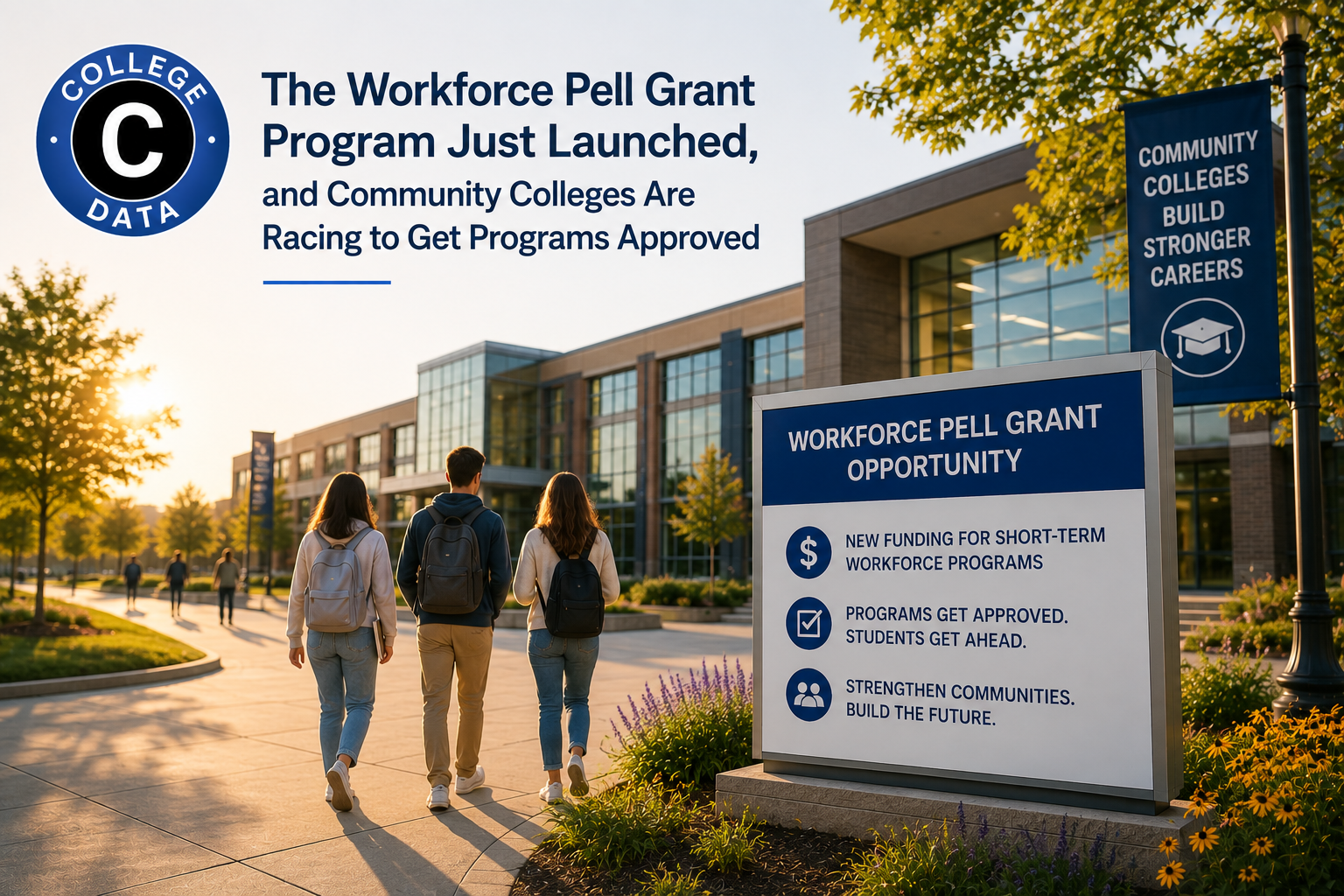
A genuinely new federal funding mechanism just went live, and community colleges are moving quickly to capture it. Iowa has become the first state approved to participate in the new Workforce Pell Grant program, allowing low-income students to use Pell Grants for Iowa Central Community College's emergency medical technician program, a short-term, career-focused offering that would not have qualified for federal aid under the traditional Pell Grant eligibility framework.
For community college leadership, this represents a genuine, immediate opportunity to expand access to career-focused programs that have historically operated outside the reach of federal financial aid, and institutions moving quickly to get their own eligible programs approved have a real head start over competitors still working through the process.
Traditional Pell Grant eligibility has historically required programs to meet a minimum length threshold, generally excluding shorter-term certificate and workforce training programs regardless of how directly they lead to employment. The Workforce Pell Grant program extends federal aid eligibility specifically to qualifying shorter-term programs tied to high-demand occupations, opening federal funding access to exactly the kind of fast, career-focused training that community colleges have long argued deserves this support but historically could not access.
Iowa's approval for its EMT program represents the first concrete implementation of this new eligibility framework, and other states and institutions are watching closely to understand both the approval process and the practical enrollment impact this kind of expanded aid access actually produces once implemented.
Community colleges with existing short-term workforce programs in high-demand fields, healthcare, skilled trades, technology certifications, now have a real incentive to pursue Workforce Pell Grant eligibility for those programs specifically, since successful approval can meaningfully expand the pool of students able to afford enrollment without relying entirely on out-of-pocket payment or employer sponsorship. This is not a slow-moving opportunity institutions can approach at a leisurely pace. Programs approved earlier gain a genuine competitive advantage in marketing to prospective students specifically seeking federally-supported pathways into these fields, while institutions still working through the approval process risk losing prospective students to competitors who have already secured this funding access.
"The Education Department's approval allows low-income students to use Pell Grants for Iowa Central Community College's emergency medical technician program."
Pursuing Workforce Pell Grant approval requires genuine institutional capability many community colleges have not previously needed to develop with this specific focus, understanding the detailed eligibility criteria for program length, occupational demand alignment, and completion outcome requirements the framework establishes. Financial aid offices and workforce program directors are having to coordinate closely on applications in a way that has not always been standard practice, since this specific approval process touches both financial aid compliance expertise and workforce program design simultaneously.
Institutions moving fastest on this are building dedicated internal capacity for tracking and pursuing Workforce Pell Grant eligibility across their broader portfolio of short-term programs, rather than pursuing approval for a single flagship program and stopping there, recognizing that multiple programs across different occupational areas may each independently qualify and each represent genuine additional enrollment opportunity.
Once a program secures Workforce Pell Grant eligibility, institutions have a genuinely new, concrete value proposition to communicate to prospective students who may have previously assumed a short-term workforce program was financially out of reach without federal aid support. This creates real, immediate demand for updated marketing materials, admissions counselor training on the new eligibility framework, and outreach specifically targeting prospective students in the income range this program is designed to serve, a population that may not have previously considered these specific programs viable given the historical lack of federal aid access.
Institutions that move quickly to update recruitment messaging once approval comes through, rather than treating the approval itself as the finish line, are positioned to capture genuine enrollment growth from students who would not have previously considered these programs financially accessible.
Community colleges with strong existing programs in healthcare, skilled trades, and technology fields, sectors facing genuine, well-documented workforce shortages nationally, represent the clearest near-term opportunity, since these are precisely the occupational areas the Workforce Pell Grant framework is designed to support. Institutions in states that move quickly to establish clear state-level approval processes, following Iowa's lead, will likely see their own institutions positioned to pursue approval faster than institutions in states still developing their own implementation framework.
Rural and smaller community colleges, often serving communities where workforce training represents a particularly consequential pathway to stable employment, have a genuine opportunity here too, though they may face real capacity constraints in building the institutional expertise needed to navigate the approval process without dedicated staff time allocated specifically for this purpose.
Consider a community college with an established phlebotomy certification program, a genuinely short-term offering, typically completed in a matter of months, that has historically operated entirely outside federal aid eligibility given its length. Students paying out of pocket, often working part-time jobs to cover tuition and living expenses simultaneously, represent a meaningfully smaller pool than the institution could serve if federal aid access were available, and many prospective students likely never seriously consider the program at all, assuming correctly under the previous framework that federal aid simply was not available for a program this short.
Under the new Workforce Pell Grant framework, this same program may now qualify for federal aid eligibility, assuming it meets the specific occupational demand and completion outcome criteria the framework establishes. Successful approval transforms the institution's actual value proposition to prospective students overnight, and institutions moving quickly to both secure this approval and update their recruitment messaging accordingly stand to capture genuine, measurable enrollment growth from a population that would not have previously considered the program financially viable.
Securing Workforce Pell Grant eligibility is not simply a matter of submitting existing program documentation to a new funding category. The framework's specific eligibility criteria around occupational demand alignment and completion outcome tracking often require institutions to build or formalize data collection and reporting processes many have not previously maintained with this level of rigor for their shorter-term programs specifically. Institutions need to demonstrate genuine alignment with documented workforce demand in their region, which requires labor market data analysis many workforce program offices have not historically needed to conduct as part of routine program administration.
This means institutions serious about pursuing this opportunity should expect the application and approval process to require genuine staff time and, in some cases, new data infrastructure investment, not simply a straightforward paperwork submission. Institutions underestimating this preparation requirement risk submitting applications that face delays or rejection due to incomplete documentation, losing valuable time relative to competing institutions that invested more thoroughly in preparation before submitting their own applications.
Since Iowa's approval represents the first concrete implementation of this framework, the practical approval process and specific state-level requirements remain in relatively early stages of development nationally, meaning institutions in different states may face meaningfully different timelines and requirements depending on how quickly their own state has built out implementation infrastructure. Institutions should track their own state's specific process closely, potentially connecting directly with peer institutions in states further along in implementation, including Iowa specifically, to understand practical lessons learned before beginning their own application process.
This state-level variation also means the pace of expansion nationally will likely be genuinely uneven, with some states seeing multiple institutions secure approval within the first year while others lag considerably behind given slower state-level implementation infrastructure. Institutions in slower-moving states should not necessarily wait passively for their state to catch up, since proactive engagement with state higher education agencies can sometimes accelerate implementation timelines that might otherwise move more slowly without direct institutional advocacy pushing the process forward.
Institutions pursuing Workforce Pell Grant eligibility should also consider how genuine employer partnerships can strengthen both the approval application itself and the program's practical outcomes once implemented. Programs with documented employer commitment, whether through guaranteed interview pathways, direct hiring partnerships, or employer input into curriculum design, often present a stronger case for occupational demand alignment than programs without this kind of direct employer connection, since the framework's underlying goal is genuinely connecting students to real, available jobs rather than simply expanding credential access in the abstract.
Institutions without existing employer partnerships in their target occupational area should consider building these relationships as part of their broader Workforce Pell Grant strategy, not as a separate initiative disconnected from the funding opportunity itself. A program that can point to specific, named regional employers actively hiring its graduates presents a considerably stronger overall case, both for initial approval and for the ongoing enrollment marketing that follows successful implementation.
This is not the only sector navigating a genuinely new, fast-moving federal or institutional shift creating real urgency this year. K-12 districts are facing a related emerging challenge too, since AI deepfakes are supercharging cyberbullying, forcing districts to build an entirely new response playbook many have never needed before. Healthcare organizations can find useful terminology grounding directly too, and Physician Data's glossary offers context for exactly this kind of workforce disruption.
Government agencies are managing a related compliance scramble too, since state legislatures passing thousands of new technology bills this year have created a patchwork most local governments were not staffed to handle, and K-12 hiring reflects a comparable pipeline collapse too, since districts once fielding 150 applications for a teaching posting are now fielding two.
The Workforce Pell Grant program represents a genuine, concrete expansion of federal aid access to exactly the kind of career-focused programming community colleges have long argued deserves this support. Institutions moving quickly to identify eligible programs, navigate the approval process, and update their enrollment marketing accordingly are positioned to capture real, near-term enrollment growth in a way institutions still waiting to understand this new framework are not. Given how directly this framework addresses workforce shortages in fields the broader economy genuinely depends on, healthcare, skilled trades, and technology chief among them, institutions building genuine expertise in this specific funding mechanism now are positioning themselves for a durable, ongoing advantage as the program continues expanding to additional states and institutions over the coming enrollment cycles.
Ready to reach the workforce program directors and admissions leaders navigating this new funding opportunity? Build a higher education marketing database, or buy a college email list, with College Data today.



 0
0
POST A COMMENT